


The Solar System's Deep Freeze
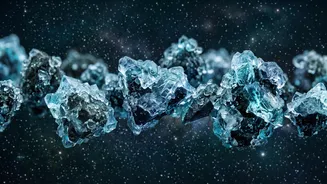
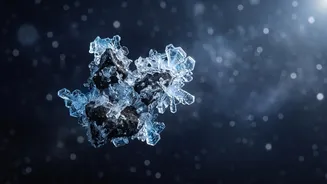
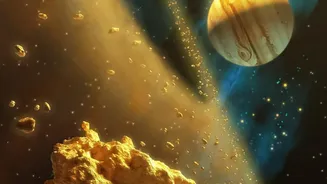
Beyond the orbit of Neptune lies the Kuiper Belt, a vast, frigid ring of icy bodies left over from the formation of the solar system more than 4.5 billion years ago. Think of it as a cosmic deep freeze, preserving the primordial materials from which planets,
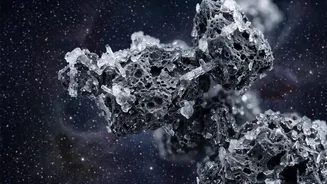
moons, and everything else were made. For a long time, scientists have believed that objects from this region, particularly comets, could have been a primary source for Earth's water, delivering it via countless impacts during the planet's early, chaotic history. To test this, researchers look for clues not by flying to these distant objects, but by catching the microscopic dust they shed. High-altitude NASA aircraft fly through the stratosphere, collecting these interplanetary dust particles (IDPs) that have journeyed from the solar system's outer rim.
A Chemical Fingerprint in Water
The key to tracing water's origin lies in its chemical fingerprint, specifically its oxygen isotopes. Oxygen typically has 8 protons, but it can have a varying number of neutrons. The most common form is light oxygen-16 (8 protons, 8 neutrons). Heavier, rarer versions include oxygen-17 and oxygen-18, which have one or two extra neutrons, respectively. The ratio of these heavy to light isotopes in a water sample can reveal where it formed. Water on Earth has a well-established isotopic ratio, a standard against which all extraterrestrial water is compared. For decades, a major theory has been that ultraviolet light in the early solar nebula separated these isotopes, leaving water ice in the outer solar system enriched with heavy oxygen. Finding proof, however, has been difficult because most materials that reach Earth, like meteorites, are from more mixed-up regions of the solar system.
A Surprising Discovery in Dust
A recent study published in 'Science Advances' provides compelling new evidence. A team led by NASA scientist Lindsay Keller analyzed 12 microscopic dust particles confirmed to be from the Kuiper Belt. They knew the origin because the grains were covered in a high density of tiny tracks left by solar energetic particles, scars from a long journey through space. Inside these grains, they found hydrated minerals like saponite and serpentine, which can only form through reactions with liquid water at low temperatures. When the team analyzed the oxygen locked within these minerals, they found it was significantly 'heavier'—enriched in oxygen-17 and oxygen-18—than the water found in Earth’s oceans. This suggests the water that formed these minerals came from a completely different and isolated source.
Rethinking Our Watery Origins
This discovery provides the first strong evidence for a massive reservoir of 'heavy' water existing in the Kuiper Belt, one that remained largely separate from the materials that formed the inner solar system, including Earth. So, what does this mean for the long-held theory that comets from this region gave us our oceans? It complicates things. While some Kuiper Belt comets, like Hartley 2, were previously found to have Earth-like water, this new data shows that the water composition out there is not uniform. It suggests that while outer solar system bodies may have contributed some water, they might not be the primary source we once thought. Instead, it forces us to reconsider other sources, such as asteroids from the outer asteroid belt, which have shown a closer isotopic match to our planet's water. It also points to the possibility that the giant planets, like Jupiter, may have acted as a barrier, preventing much of this heavy water from migrating inward.