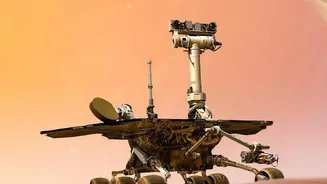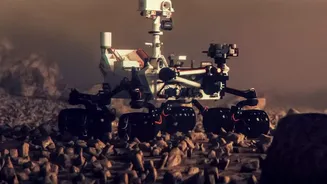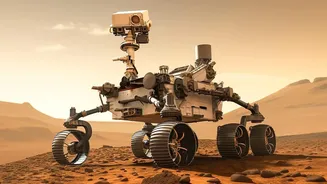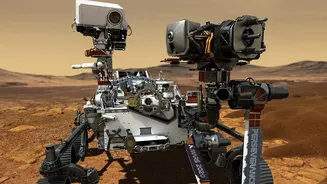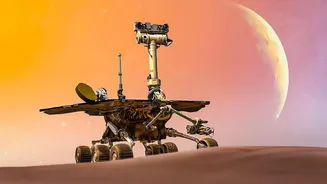




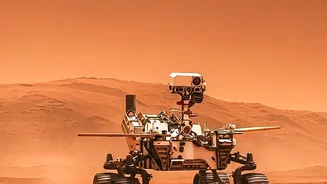


For years, NASA's Perseverance rover has been drilling and storing precious samples of Martian rock, each a potential key to unlocking the Red Planet's secrets. But one enormous question has loomed: how do we get them home? Now, there's a new answer.
Introducing the PSRA Initiative
NASA has kickstarted a fresh effort to solve the complex puzzle of the Mars Sample Return (MSR) mission. It's called the Perseverance Sample Retrieval Architecture, or PSRA for short. Announced on November 9, 2026, this new initiative is designed to create a clear, focused strategy for retrieving the samples collected by the Perseverance rover and delivering them safely to Earth. The MSR mission has been a top priority for decades, but has been hampered by technical challenges and ballooning costs, with some previous estimates soaring to $11 billion and pushing the return date to 2040. This new PSRA plan represents a major push to streamline the process, making it more efficient and affordable. A dedicated team will begin its work in January 2027, with the goal of presenting a final report with impartial recommendations by the winter of 2027-2028.
Learning From Past Hurdles
The MSR program has been described as one of the most ambitious robotic space missions ever conceived. The joint effort with the European Space Agency (ESA) involves multiple spacecraft and the first-ever rocket launch from the surface of another planet. However, independent reviews highlighted significant concerns about the original plan's complexity, cost, and timeline, which NASA itself deemed unacceptable. The PSRA was born from this necessity to rethink the approach. Its core mandate is to review the lessons learned from previous plans, assess current technological capabilities, and evaluate all acquisition options to find a viable path forward. The goal is to bring the samples home sooner—potentially by the mid-to-late 2030s—and for a more manageable cost, with some revised appraisals suggesting a feasible price tag of around $8 billion.
The Scientific Holy Grail
So why go to all this trouble? The samples collected by Perseverance are a scientific treasure trove. The rover has been methodically drilling into the floor of Jezero Crater, an area believed to have once been a river delta and lake. These carefully selected cores of rock and soil could hold the answer to one of humanity's most profound questions: did life ever exist on Mars? To date, Perseverance has collected a diverse suite of samples, including igneous and sedimentary rocks, and even a sample of the Martian atmosphere, all sealed in pristine titanium tubes. Studying these materials in advanced laboratories on Earth will allow scientists to analyze them with equipment far too large and complex to send to Mars, potentially revolutionizing our understanding of planetary formation, climate change, and astrobiology.
The Interplanetary Space Race?
While science is the primary driver, there's another factor adding urgency to NASA's mission: international competition. China is making significant progress with its own Mars sample return mission, Tianwen-3. Chinese officials have stated they aim to launch their mission around 2028 and return samples to Earth by 2031. This timeline has been cited in some reports as a 'forcing factor' for NASA to accelerate its own efforts. While NASA officials focus on the scientific and engineering imperatives, the geopolitical backdrop undoubtedly adds another layer of complexity and motivation. The PSRA's success in creating a workable plan will be crucial not only for science but also for maintaining a leading position in space exploration.