

What Is The ISS and Why Can We See It?
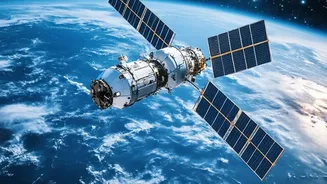
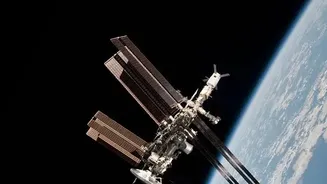
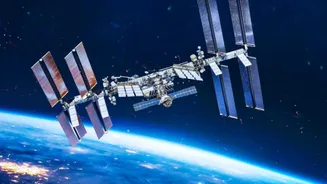
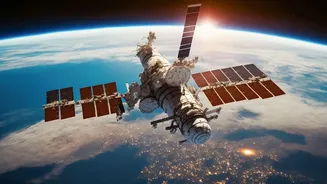
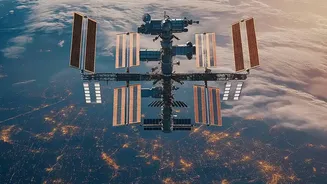
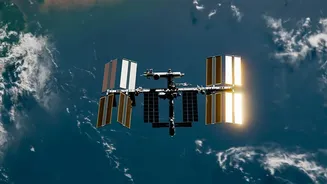
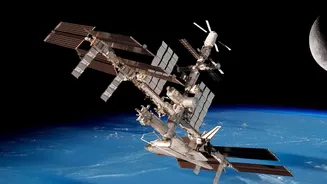
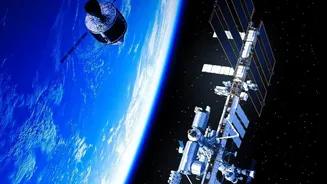
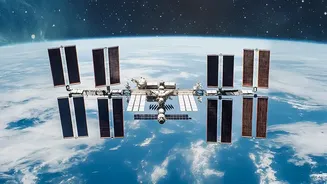
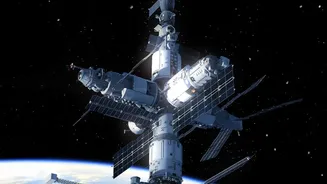
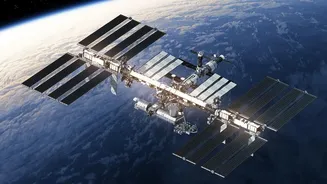
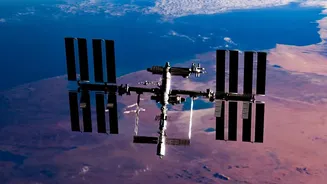
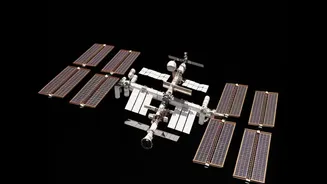
The International Space Station (ISS) is a large spacecraft and science laboratory orbiting Earth at an altitude of approximately 400 kilometres. It is the largest artificial object in space and serves as a home for international crews of astronauts and cosmonauts.
We can see it from the ground for the same reason we can see the Moon: it reflects sunlight. Despite being in Earth's shadow as it orbits, its high altitude means it can still be illuminated by the sun, especially during the hours just after sunset or before sunrise. Its large solar arrays are highly reflective, making it appear as a very bright, star-like object to observers on the ground. Think of it as a massive, fast-moving mirror in the sky.
The Perfect Time for a Sighting
You can't just look up at any time of night and expect to see the ISS. The best viewing opportunities occur during twilight hours—specifically, the first couple of hours after sunset and the last couple of hours before sunrise. This is the magic window when the sky in your location is dark enough to see stars, but the ISS, at its high altitude, is still bathed in sunlight. It will not be visible in the middle of the night when it passes through Earth's shadow, nor will it be visible during the day when the sky is too bright. A typical sighting lasts between three and six minutes, giving you a brief but memorable window to watch it travel from one horizon to the other.
Essential Tools for Tracking the Station
While you don't need a telescope—the ISS is visible to the naked eye—you do need to know when and where to look. Thankfully, technology makes this incredibly simple. The best resource is NASA's own 'Spot The Station' service. By signing up with your email or mobile number on their website, you will receive alerts a few hours before the ISS is scheduled to fly over your specific location. The alert will tell you the exact time the sighting will start, the direction to look, how high it will appear in the sky, and how long it will be visible. For those who prefer apps, several excellent options are available for both Android and iOS. Apps like 'ISS Detector', 'Heavens-Above', and 'SkyView Lite' not only provide precise timings but also use your phone's compass and GPS to show you exactly where to point your gaze in the sky.
Knowing What to Look For
First-time spotters often confuse the ISS with an airplane, but there are key differences. The ISS looks like a very bright, solid point of light—like a planet or a brilliant star. The key distinction is its movement. It travels across the sky steadily and much faster than you might expect. Unlike an airplane, the ISS does not have flashing or blinking lights; it is a single, constant beacon of light. It also moves silently, without the distant hum of an aircraft engine. When you see it, you will notice it emerge from one part of the horizon, travel in a smooth arc across the sky, and then disappear into the other side as it enters Earth's shadow or dips below the horizon.
Your Step-By-Step Sighting Guide
Ready to give it a try? Follow these simple steps. First, sign up for NASA's 'Spot The Station' alerts or download a reliable tracking app to find out the next viewing opportunity for your city. On the day of the sighting, plan to go outside about five to ten minutes before the scheduled time to let your eyes adjust to the dark. Open your tracking app or check your alert for the direction in which the station will first appear—for example, 'appearing in the southwest'. Face that direction and scan the sky. As the exact time arrives, look for a new 'star' that is moving purposefully across the starfield. Then, just watch in awe as this incredible outpost of human ingenuity glides across your sky for a few minutes before vanishing once again.