





Understanding the Cat-Cow Pose
Cat-Cow, or Marjaryasana-Bitilasana, is a dynamic flow between two poses. It's performed on your hands and knees and involves moving your spine from a rounded position (Cat) to an arched one (Cow). This sequence is celebrated as a warm-up for its ability
to increase spinal flexibility, improve posture, and connect movement with breath. It gently stretches the front and back of the torso, massages the abdominal organs, and helps relieve tension in the back and shoulders. By synchronising the movement with your inhales and exhales, it becomes a meditative practice that calms the mind and enhances body awareness.
Why a Neutral Neck Is Crucial
In yoga, the neck (cervical spine) is considered an extension of the rest of the spine. When you move into Cow Pose, the common tendency is to crane your neck back to look up at the ceiling. In Cat Pose, many people forcefully tuck their chin to their chest. Both movements can compress the vertebrae in your neck, leading to strain, discomfort, or even long-term injury. A neutral neck means maintaining the natural curve of your cervical spine, keeping it long and in line with your torso. This protects the delicate structures of the neck, reduces tension, and allows the stretch to be focused where it's intended: along the full length of your spine.
Step 1: The Starting Tabletop Position
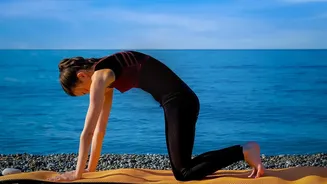
Before you begin the flow, establish a solid foundation. Come onto your hands and knees. Align your wrists directly under your shoulders and your knees directly under your hips, about hip-width apart. Spread your fingers wide to distribute your weight evenly across your palms. Your spine should be in a neutral, straight line, from the crown of your head to your tailbone. To find the correct neck position here, soften your gaze and look down at the floor just in front of your hands. Engage your core slightly to support your lower back.
Step 2: Cow Pose (Bitilasana) with a Long Neck
As you inhale, begin the movement into Cow Pose. Start by dropping your belly toward the mat and lifting your tailbone toward the sky, creating an arch in your back. Broaden your collarbones and draw your shoulders away from your ears. Instead of throwing your head back to look up, think about keeping the back of your neck long. Your gaze should lift gently forward or slightly upward, but not so far that you feel a 'crunch' in your neck. The goal is to create a long, gentle curve from your tailbone to the base of your skull, not a sharp angle.
Step 3: Cat Pose (Marjaryasana) without Force
On your exhale, reverse the movement into Cat Pose. Press through your hands and start to round your spine toward the ceiling, tucking your tailbone under. Imagine a string pulling the middle of your back upwards. As your back rounds, allow your head to release naturally. Avoid actively forcing your chin to touch your chest; this creates unnecessary tension. Instead, let the crown of your head point toward the floor, keeping the neck relaxed as a natural extension of your rounded spine. The movement should feel like a release, not a forceful crunch.
Common Mistakes to Avoid
Beyond the neck, a few other common errors can reduce the effectiveness of this pose. One is rushing through the movements. Cat-Cow is most beneficial when you move slowly and mindfully, allowing each inhale and exhale to guide the full range of motion. Another mistake is shrugging your shoulders up toward your ears, which creates tension in the upper back and neck. Consciously keep your shoulders drawn down and back. Finally, avoid locking your elbows; keep a micro-bend in them to protect the joints and maintain engagement in your arms.