





A Discovery in an Unlikely Place
Planetary scientists were stunned to find patches of water frost on the summits of the Tharsis volcanoes, the tallest in our solar system. This region, which includes the famous Olympus Mons—a volcano as wide as France and nearly three times the height
of Mount Everest—is near Mars's equator. Until now, it was widely believed that the combination of intense sunlight and the thin Martian atmosphere in this area would keep temperatures too high for frost to form. The discovery, made using data from the European Space Agency's ExoMars Trace Gas Orbiter and Mars Express missions, challenges long-held assumptions about the Martian climate. It was a case of knowing where and when to look; the frost is only visible for a few hours around sunrise.
How a Fleeting Frost Survives
The frost is incredibly delicate, likely no thicker than a human hair. It forms overnight within the giant craters, called calderas, at the volcanoes' summits. Researchers believe a unique microclimate is responsible for this phenomenon. Winds travel up the massive slopes of the volcanoes, carrying moist air from near the surface to higher, colder altitudes. Inside the sheltered calderas, this moisture condenses and settles as a fine layer of water ice frost. As the morning sun rises, the frost quickly evaporates, or sublimates, turning directly into vapour in the thin air. This daily cycle involves a staggering amount of water—an estimated 150,000 tons, equivalent to about 60 Olympic-sized swimming pools, moves between the surface and the atmosphere each day during the colder seasons.
Water Ice, Not Dry Ice
An important step for scientists was to confirm what the frost was made of. Mars has a lot of carbon dioxide (CO2) in its atmosphere, which can also freeze and form what is known as 'dry ice'. The planet's polar caps, for instance, have a seasonal layer of CO2 frost. However, by modelling the temperatures inside the volcano calderas, the team determined that it was too warm for carbon dioxide to freeze. The temperatures were, however, just right for water vapour to condense into ice, confirming that these equatorial peaks were indeed dusted with a morning layer of frozen water.
The Patterns Left Behind
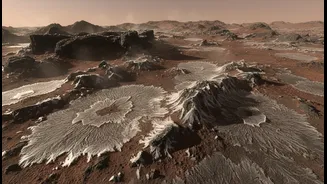
The repeated process of frost forming and sublimating is not just a fleeting spectacle; it leaves its mark on the Martian surface. The headline's mention of "visible surface patterns" refers to the subtle changes this cycle creates. As the ice vanishes, it can alter the brightness of the ground and contribute to phenomena like dark streaks seen on slopes. Over long periods, the freezing and thawing of water, a process known as frost wedging, can break down rocks and create distinct polygonal patterns in the soil. While the newly discovered caldera frost is extremely thin, its presence points to an active water cycle that could be linked to these larger geological patterns observed elsewhere on the planet, revealing a more dynamic and geologically active Mars than previously thought.
Why This Finding Is Important
This discovery is more than just a curiosity; it fundamentally changes our understanding of Mars's water cycle. It shows that water is more widely distributed and mobile on the planet than we knew. Finding water, even in the form of a thin, temporary frost, is crucial for planning future human and robotic exploration. Water is a critical resource for any potential long-term presence on Mars. Furthermore, understanding how and where water moves today helps scientists piece together the planet's past, including whether it could have once supported life. This small amount of frost on a volcanic peak could be a remnant of an ancient, more active climate cycle, giving us new clues to unravel the Red Planet's biggest secrets.