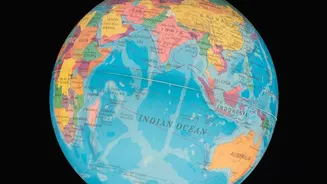









Every clock in India, from a smartphone in Gujarat to a wall clock in Arunachal Pradesh, follows a single, unified time. This synchronicity is dictated by an imaginary line: the meridian at 82.5 degrees East longitude. But why this specific line?
The Line That Unites a Nation
Indian
Standard Time (IST) is the time observed across the entire country, set at five and a half hours ahead of Coordinated Universal Time (UTC+5:30). This standardisation is based on the 82.5° East longitude. This imaginary line, known as the Standard Meridian of India, passes through the town of Mirzapur in Uttar Pradesh. Geographically, this meridian was chosen because it lies almost perfectly in the middle of India's vast longitudinal expanse, which stretches from approximately 68°E in the west to 97°E in the east. By selecting a central line, the founders of IST aimed to create a uniform time that would minimise the time difference between the country's eastern and western extremities. This single time simplifies everything from railway and flight schedules to nationwide broadcasts and official administrative work.
A History of Many Times
Before the adoption of a unified time, India was a patchwork of different local times. Major cities like Bombay (now Mumbai) and Calcutta (now Kolkata) operated on their own time zones, determined by their respective longitudes. Bombay Time was 4 hours and 51 minutes ahead of GMT, while Calcutta Time was 5 hours and 30 minutes and 21 seconds ahead. The expansion of the railway network in the mid-19th century exposed the chaos of this system, making a unified time essential for coordinated transport. Initially, 'Madras Time' was used by many railway companies as an intermediate standard. The decisive step came in 1905, when British India officially adopted the 82.5°E meridian as the basis for a single time zone, which came into effect on January 1, 1906. However, Bombay and Calcutta retained their own local times until 1955 and 1948, respectively, before finally joining the national standard.
Who Keeps India's Time?
The official responsibility for maintaining and disseminating IST lies with the CSIR-National Physical Laboratory (NPL) in New Delhi. Far from a simple clock, the NPL uses a bank of highly precise caesium atomic clocks and a hydrogen maser to keep time. These sophisticated instruments are so accurate that they would lose or gain only about one second in millions of years. This ensemble of clocks generates a timescale traceable to the global Coordinated Universal Time (UTC), ensuring that IST remains accurate to within a few nanoseconds. This ultra-precise timekeeping is crucial for modern infrastructure, including banking systems, 5G telecommunications, satellite navigation, and the national power grid.
The Great Time Zone Debate
Despite its administrative benefits, India's single time zone is a subject of ongoing debate. The country's wide geographical spread means there is a nearly two-hour difference in local solar time between its eastern and western borders. In states like Arunachal Pradesh and Assam, the sun rises as early as 4 a.m. in summer, long before offices and schools open, leading to a loss of productive daylight hours. Conversely, early sunsets in the east increase electricity consumption for lighting. To cope, tea gardens in Assam have long used an informal 'Chai Bagan Time', which is one hour ahead of IST, to better align work schedules with daylight. Proponents argue that introducing a second time zone (often proposed as IST-II at UTC+6:30) for the northeastern states could save energy, improve productivity, and better align with the natural circadian rhythms of the population.
Why One Time Zone Still Prevails
Despite compelling arguments for a change, the Indian government has consistently opted to maintain a single time zone. The primary reasons cited are administrative simplicity and national unity. Officials have expressed concerns that two time zones could create significant logistical challenges and confusion, particularly for the Indian Railways, which operates one of the world's largest networks. The potential for accidents and scheduling chaos at the point where the time zones meet is a major deterrent. Critics of the two-zone proposal argue that the benefits of a unified time for transport, communication, and business outweigh the regional disadvantages. For now, the vision of 'One Nation, One Time' holds, making the 82.5°E meridian a line that continues to shape the daily lives of over a billion people.