


A Cosmic Collision in Progress
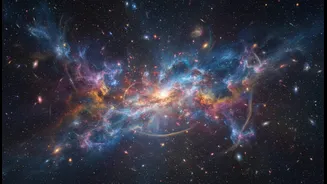
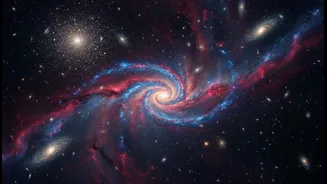
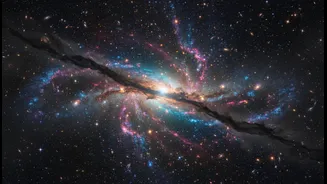
Deep in the constellation Columba lies MACS J0553.4-3342, a structure so vast it defies easy comprehension. This isn't a single galaxy, but two massive clusters of galaxies, each containing countless stars, planets, and dust clouds, hurtling towards each other
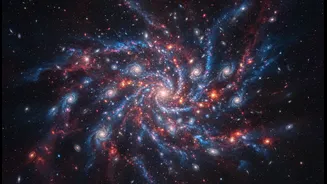
in a gravitational dance. We are seeing this event as it was 4.4 billion years ago. Galaxy clusters are the largest known structures in the universe held together by gravity, and watching two of them merge is like witnessing the formation of a cosmic subcontinent. Observations from the Hubble and Webb telescopes confirm that MACS J0553.4-3342 is composed of two sub-clusters of roughly equal mass that are in the active process of merging.
The 'Construction' Gets Messy
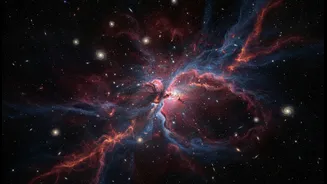
The term 'building site' is more than just a catchy phrase; it's an apt description of a chaotic and profoundly creative process. The two sub-clusters have already passed through each other, and are now separated by over a million light-years. However, their mutual gravity is so immense that they will inevitably fall back together again and again, until they finally combine into one enormous cluster. This cosmic smash-up is incredibly messy. The space between the galaxies is filled with extremely hot gas that is invisible to the naked eye but radiates powerfully in X-rays. This chaotic environment is the crucible where new cosmic structures are forged.
A Webb of Discovery
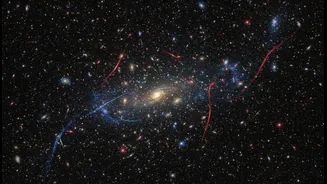
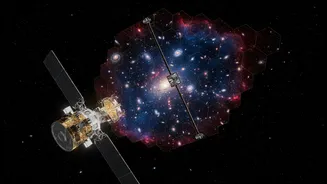
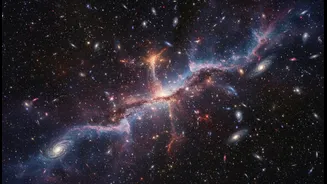
Capturing such a distant and dynamic event in detail required the unparalleled power of the James Webb Space Telescope (JWST). Its Near-Infrared Camera (NIRCam) pierced through cosmic dust to give astronomers a stunningly clear view. The observations are part of a survey program designed to take deep, high-quality images of massive galaxy clusters. Each of the two merging sub-clusters is anchored by a huge, bright elliptical galaxy, visible as the two brightest points of light in the images Webb sent back. Dozens of smaller, fainter galaxies are caught in the gravitational pull, destined to be incorporated into the final, larger cluster.
A Lens to the Early Universe
This cosmic construction site is also a valuable tool for astronomers. The immense concentration of mass in MACS J0553.4-3342 is so great that it visibly bends the fabric of spacetime. This creates a phenomenon known as gravitational lensing, where the cluster acts like a giant magnifying glass for objects located even farther away. In the images from Webb, faint orange arcs are visible—these are the distorted images of background galaxies whose light has been warped and magnified by the cluster. This natural telescope allows scientists to study extremely distant and faint objects from the early universe, like young galaxies and even individual stars, that would otherwise be impossible to see.