


Our Comforting Earth-Based Clock
Think about how you measure your day. It’s a simple, intuitive cycle: the sun rises, you work, you rest, and it sets. A 'day' is one rotation of our planet. A 'year' is one lap around the sun. This cosmic clockwork is so deeply ingrained in our biology
and culture that we take it for granted. Our entire system of seconds, minutes, hours, and calendars is a brilliant human invention designed to make sense of this one specific planetary dance. But here’s the catch: the universe doesn’t use the same dance sheet. The elegant timekeeping we rely on is a purely local phenomenon. As astronomers peer deeper into the galaxy, they are finding worlds where the very concepts of 'day' and 'year' become fantastically warped, and sometimes, utterly meaningless.
Worlds Without a Sunrise
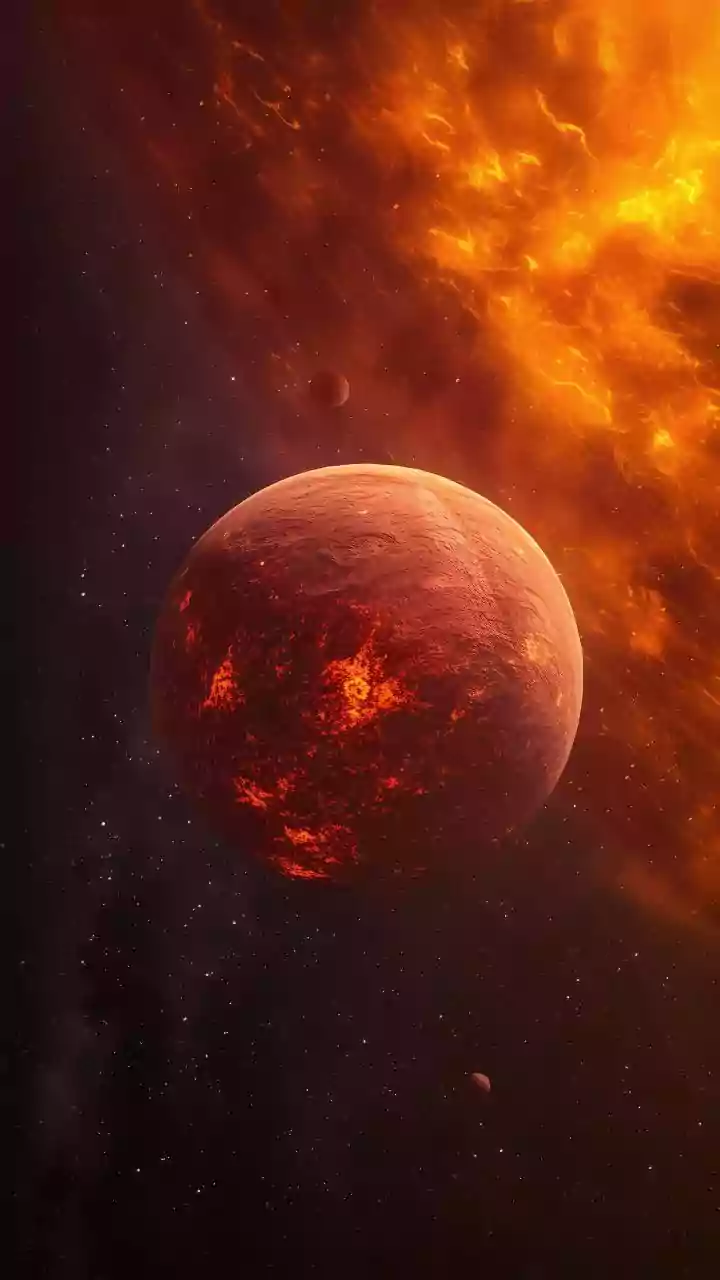
Imagine a planet where one side is trapped in eternal, scorching daylight and the other in a perpetual, frozen night. This isn't science fiction; it's a common phenomenon called 'tidal locking'. It happens when the gravity of a star is so strong that it forces a planet to stop spinning relative to it, much like how the same side of our Moon always faces Earth. On these tidally locked exoplanets, often found orbiting small, dim red dwarf stars, a 'day' in the rotational sense no longer exists. There is no sunrise or sunset to mark the passage of time. Instead, you have a permanent 'hot pole' facing the star and a 'cold pole' facing away, with a twilight zone of potential habitability in between. How do you measure a day on a world that doesn’t have one? The question itself reveals how Earth-centric our thinking is.
The Strange Rhythm of Pulsar Planets
If tidally locked worlds are strange, planets orbiting pulsars are in a league of their own. A pulsar is the hyper-dense, collapsed core of a massive star that has gone supernova. It spins hundreds of times per second, blasting out beams of radiation like a cosmic lighthouse. Incredibly, the very first exoplanets ever discovered were found orbiting a pulsar named PSR B1257+12. Life as we know it would be impossible there, constantly bathed in lethal radiation. But their time metrics are fascinating. Because they orbit so close to the tiny but massive stellar remnant, their 'years' are incredibly short. One of these worlds, Draugr, completes an orbit every 25 Earth days. Its neighbour, Poltergeist, takes 66 days. These are not leisurely laps but frantic, high-speed sprints around a stellar zombie, challenging our notions of a stately planetary year.
When Time Itself Stretches and Slows
This is where things get truly mind-bending. According to Einstein's theory of general relativity, gravity warps not just space, but time itself. The stronger the gravity, the slower time flows. Here on Earth, this effect is minuscule and only detectable by hyper-accurate atomic clocks. But near an object with immense gravity, like a neutron star or a black hole, the effect is dramatic. If you could hover in a spaceship near a black hole while your friend stayed a safe distance away, you would age more slowly. When you returned, you would be younger than them. This isn't a paradox; it's a proven physical reality. For any planet unlucky enough to orbit such a cosmic monster, time would literally tick at a different rate compared to the rest of the universe. For its inhabitants, if any could exist, a minute might be an hour for everyone else. This forces us to abandon the idea of a single, universal 'now'.
Creating a New Cosmic Calendar
Faced with this cosmic diversity, astronomers have had to adapt. They can’t rely on Earth-centric terms like 'day' to compare planets. Instead, they use objective, mathematical measurements: the 'rotational period' for a planet’s spin and the 'orbital period' for its year. But the bigger shift is conceptual. We are learning to de-couple our human experience of time from the physical mechanics of the cosmos. Each new, bizarre world we discover is a lesson in humility. It reminds us that our reality is just one of countless possibilities. The universe is not designed for our convenience or comprehension; it simply is. The challenge, and the joy, for science is to stretch our minds to try and grasp these alien realities.