





More Than Just a Pretty Picture
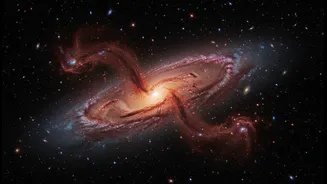
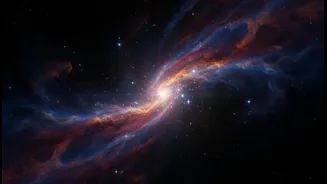
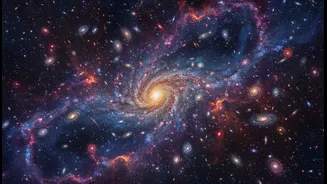
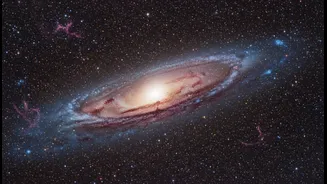
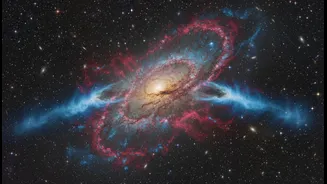
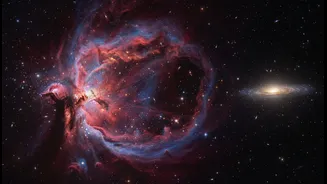
Four years after its first images transformed our view of the cosmos, the James Webb Space Telescope (JWST) continues to deliver awe-inspiring visuals. The latest anniversary image, likely a spectacular glimpse into a stellar nursery or a distant, complex
galaxy like Centaurus A, will undoubtedly grace screens worldwide. These images are cosmic masterpieces. Yet, to treat them only as art is to miss the revolution they represent. Each pixel is a data point, and each color tells a story that our eyes alone could never see. The real magic isn't just what the image shows, but what it allows scientists—and all of us—to understand about the universe.
The Science Hiding in the Colors
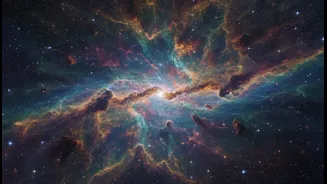
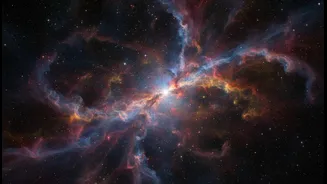
One of the biggest misconceptions about Webb's images is the color. Because Webb observes in infrared light, which is invisible to the human eye, the vibrant reds, blues, and golds are added by image processors on the ground. This isn't just for aesthetics; it's a form of data visualization. Different colors are assigned to different infrared wavelengths, each corresponding to specific chemical elements or physical features. A splash of red might indicate a dense cloud of molecular hydrogen where stars are born, while sharp blue points could be individual, older stars. This technique allows Webb to pierce through cosmic dust clouds that obscure the view of telescopes like Hubble, revealing the chaotic and beautiful processes of star and planet formation hidden within. When you see a Webb image, you are looking at a scientific map disguised as a portrait.
An Engineering Marvel a Million Miles Away
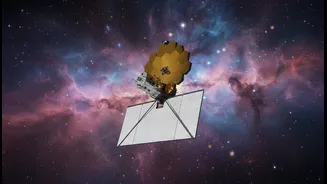
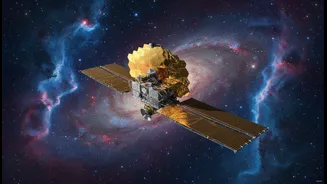
The images are so crisp and detailed that it's easy to forget the incredible engineering that makes them possible. The JWST operates a million miles from Earth, a journey that it began in late 2021. Its massive, 21-foot-wide mirror, coated in a thin layer of gold to optimize infrared reflection, is made of 18 hexagonal segments that had to unfold and align perfectly in deep space. To detect faint infrared signals from the early universe, its instruments must be kept incredibly cold—some below -220 degrees Celsius—protected by a five-layer sunshield the size of a tennis court. Every image is a testament to decades of work by thousands of people to build and operate the most powerful space observatory in history.
A Data Goldmine for Students and Scientists
For the public, an anniversary image is a single, stunning release. For astronomers and students, it's the tip of an iceberg. The raw data behind these pictures are publicly available, often immediately, through archives like the Mikulski Archive for Space Telescopes (MAST). This open-access policy has democratized space science. University students, researchers, and even dedicated citizen scientists can download and analyze the same information as NASA's top experts. These datasets contain far more information than a single processed image can show, including spectroscopic data that breaks down light into its component wavelengths. This reveals the chemical composition, temperature, and density of distant objects, from the atmospheres of exoplanets to the makeup of the first galaxies. The anniversary image is a headline; the archive is the library.
Answering Humanity's Oldest Questions
Ultimately, what we risk missing is the connection to our own origin story. Each Webb observation is a step toward answering fundamental questions: How did the first galaxies form? Where do stars and planets come from? Are we alone in the universe? By studying star-forming regions, Webb helps us understand the environment in which our own sun was likely born. By analyzing the atmospheres of planets orbiting other stars, it searches for the chemical building blocks of life. These images aren't just snapshots of a faraway place; they are pieces of a puzzle about our own cosmic history, looking back in time to understand how we came to be.