





The New Mission: Planet Earth
For decades, space exploration was the exclusive domain of government agencies, a symbol of national prestige focused on celestial bodies. Today, that paradigm has shifted dramatically. A quiet revolution is underway, driven not by interstellar travel
but by looking back at our own planet. The global space economy is booming, projected to reach nearly $2 trillion by 2040, with commercial revenues already accounting for almost 80% of the industry's activity. This growth is powered by a new mandate: using the unique vantage point of orbit to solve Earth's most pressing problems, chief among them being climate change.
An Eye in the Sky for Climate Action
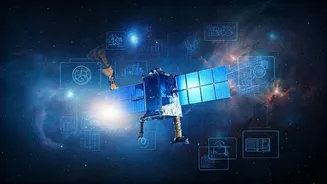
Satellites are our most powerful tool for monitoring the health of our planet. More than half of all essential climate variables can only be measured from space. Earth observation satellites provide a continuous stream of data on everything from greenhouse gas concentrations and deforestation rates to polar ice melt and ocean temperatures. This information is no longer just for scientists. It has become a critical asset for businesses and governments. Companies use this data to make their supply chains more sustainable by monitoring for illegal logging, and city planners use it to design infrastructure resilient to floods and heatwaves. For example, climate tech startups use satellite imagery to verify carbon credits from reforestation projects, ensuring investments have a real impact.
The Commercial Space Gold Rush
The plummeting cost of launching satellites, thanks to reusable rockets and miniaturisation, has opened the floodgates for private enterprise. This has created a bustling marketplace for satellite data and its applications. Businesses now offer services that were once science fiction: precision agriculture platforms that tell farmers exactly where to irrigate, saving water and boosting yields; insurance firms that assess climate risk with unparalleled accuracy; and logistics companies that optimise shipping routes based on real-time weather data. This commercialisation means the skills required have broadened far beyond traditional aerospace. The industry is hungry for talent, and not just rocket scientists.
The Skills Powering This New Economy
While aerospace and propulsion engineers remain fundamental, the fastest-growing demand is for professionals who can make sense of the vast amounts of data beamed down from orbit. Software engineers, data scientists, and AI/machine learning specialists are in high demand to build the platforms that turn raw satellite imagery into actionable insights. There's also a growing need for non-technical roles like project managers, finance experts, and policy advisors who can navigate the complex regulatory and commercial landscape of this new industry. Crucially, companies are increasingly recruiting from outside the space sector, looking for experts in cybersecurity, robotics, and even automotive engineering who can adapt their skills.
India's Ascent in the Space Arena
India is rapidly emerging as a key player in this commercial space race. The Indian government has actively nurtured a private deep-tech startup ecosystem to complement the work of the Indian Space Research Organisation (ISRO). With the establishment of IN-SPACe to license and regulate private operators, the sector is poised for significant growth. Indian startups like Skyroot Aerospace and Pixxel are already making waves in launch vehicle development and Earth observation. This push aligns with India's growing climate-tech sector, which is focused on creating cost-effective, scalable solutions for sustainability challenges, making the fusion of space and climate tech a natural fit for the nation's future.