

A Glimpse of Potentially Watery Worlds
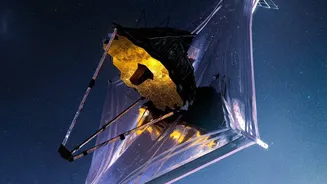
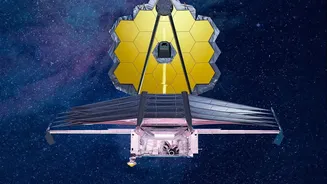
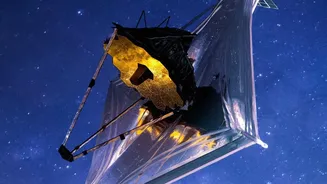
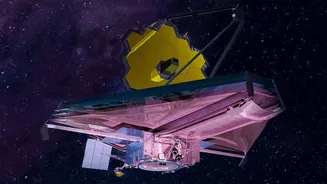
The James Webb Space Telescope has been making headlines with its ability to peer into the atmospheres of exoplanets—planets that orbit stars other than our Sun. Among its most significant findings is the repeated detection of water vapour. For example,
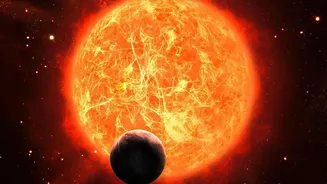
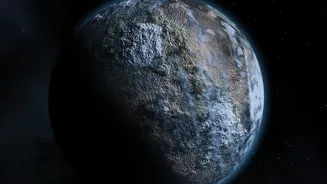
observations of WASP-96b, a 'hot Jupiter' gas giant located 1,150 light-years away, revealed clear and strong signatures of water. More recently, studies of smaller, rocky worlds and sub-Neptunes like K2-18b have also identified water vapour, sometimes alongside other intriguing molecules like methane and carbon dioxide. While the headline focuses on recent scans, this capability has been consistently demonstrated across a variety of planetary types, from massive gas giants to smaller, potentially rocky worlds, painting a diverse picture of the galaxy.
How Webb 'Tastes' a Distant Atmosphere
Detecting anything on a planet light-years away sounds like science fiction, but the method is ingenious. It's called transit spectroscopy. As an exoplanet passes in front of its host star from our perspective, a tiny fraction of the starlight filters through the planet's atmosphere. The JWST's powerful instruments, particularly its Near-Infrared Spectrograph (NIRSpec), capture this light and break it down into a spectrum, which is like a chemical barcode. Different molecules in the atmosphere absorb specific wavelengths of light, leaving unique gaps or lines in this barcode. Water vapour, carbon dioxide, and methane each have a distinct signature. By analysing which colours of light are missing, astronomers can determine the chemical makeup of an atmosphere they can never directly see. It’s the first time this level of detail has been possible for a wide range of planets.
Not Just Water, But a Chemical Menu
While water grabs the headlines, JWST provides a much fuller picture. On the gas giant WASP-39 b, the telescope detected a whole suite of chemicals, including the first-ever finding of sulfur dioxide in an exoplanet's atmosphere, which points to active chemistry driven by the star's light. On other planets, it finds sodium and potassium. Sometimes, what isn't found is just as important. The presence of some molecules and the absence of others can help scientists create models of how a planet formed and what its climate might be like. For example, some scorching hot lava worlds, which were expected to have no atmosphere at all, have shown signs of a thin one, challenging previous theories. Each detection provides another piece of the puzzle.
A Stepping Stone, Not a Smoking Gun
It is crucial to put these findings in context. Detecting water vapour does not mean we've found a habitable ocean world. Many of these planets, like the 800-degree GJ 486 b, are far too hot for liquid water to exist on the surface. The water detected is in the form of steam in the atmosphere. Furthermore, astronomers must be incredibly careful. In some cases, the water signature might actually be coming from cool spots on the host star itself, not the planet. Disentangling these signals is a major challenge. However, finding water vapour is a critical first step. It confirms that the basic ingredients for life as we know it are common throughout the galaxy. The goal is to use these techniques on smaller, cooler, Earth-like planets in the 'habitable zone'—the region around a star where liquid water could exist.
What Comes Next in the Search?
Every discovery by the JWST refines the search for life. Scientists are now moving from simply detecting molecules to understanding their relative abundances. One new theory suggests that a key sign of a planet with a large liquid ocean might be a comparative lack of carbon dioxide in its atmosphere, as the ocean would absorb it. The next generation of observations will focus not just on finding water, but on looking for these more complex 'biosignatures'—combinations of gases that are difficult to explain without biological processes. The TRAPPIST-1 system, with its multiple Earth-sized rocky planets, remains a prime target for these future deep dives. The telescope will continue to survey a wide range of worlds, building a catalogue that will help us understand just how unique—or how common—our own watery planet truly is.