



What is Space Weather?
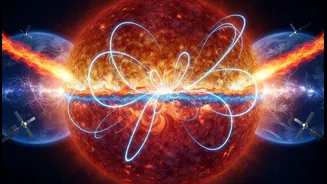
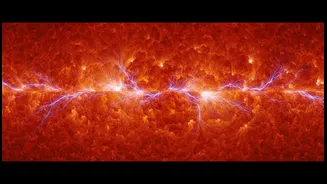
Space weather refers to the changing conditions in space, driven by the Sun's activity. Our star is constantly sending out a stream of charged particles called the solar wind. But sometimes, it unleashes much more powerful bursts of energy and matter.
These events, known as solar flares and coronal mass ejections (CMEs), can send billions of tonnes of plasma hurtling toward Earth. When these storms reach us, they interact with our planet's magnetic field. While this shield protects us from the worst of it, strong solar events can still have significant consequences. They can disrupt our increasingly technology-dependent world by damaging satellites, scrambling GPS and radio communications, and even overloading power grids, potentially causing widespread blackouts.
The Sun's Turbulent Engine Room
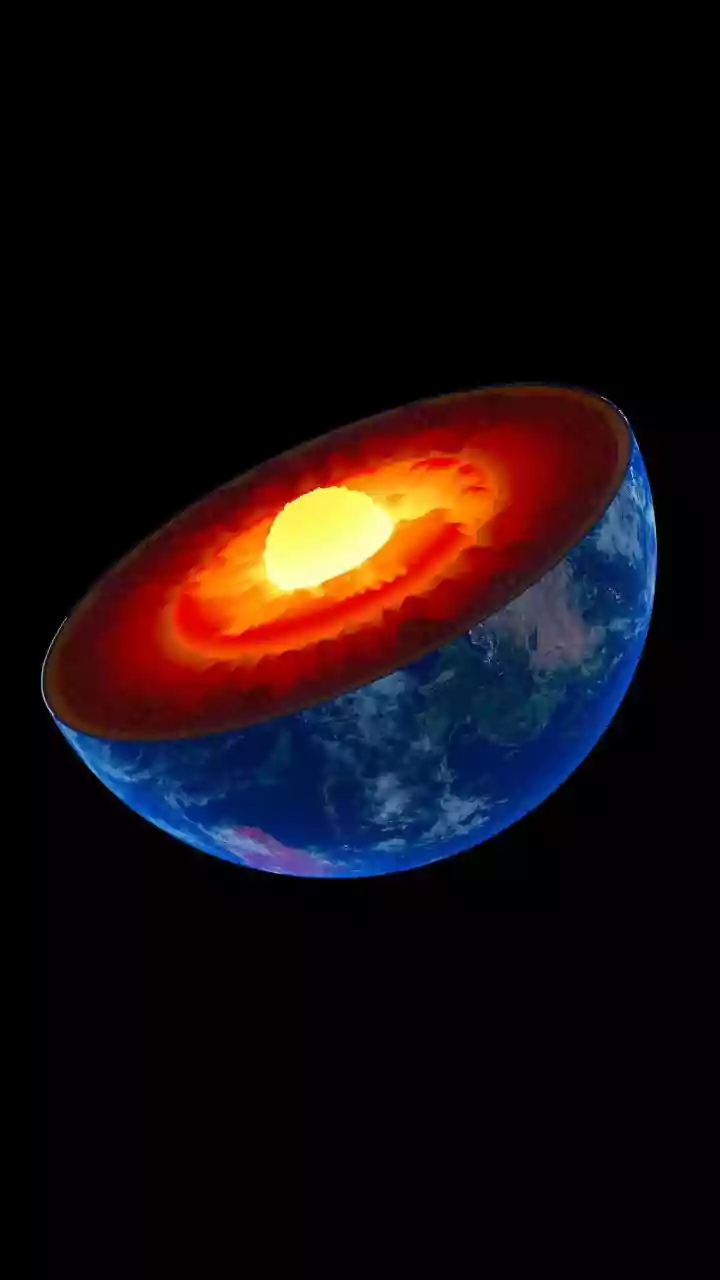
To forecast this weather, we must first understand its source. Scientists believe a crucial key lies in the solar tachocline. Imagine the Sun as a giant onion with several layers. Deep inside is the radiative zone, which rotates like a solid, unified ball. The outer layer is the convection zone, a boiling sea of plasma that rotates differentially—meaning its equator spins faster than its poles. The tachocline is the incredibly thin, turbulent boundary layer sandwiched between them. Located about two-thirds of the way out from the Sun's centre, this region is a place of immense shear, as the rigidly rotating interior grinds against the differentially rotating exterior. It is within this chaotic zone that many scientists believe the Sun's powerful magnetic field is generated.
Connecting the Tachocline to Solar Storms
The process happening in the tachocline is known as the solar dynamo. The intense shearing motion in this layer stretches and twists the Sun's magnetic field lines, amplifying their strength. Think of it like twisting a rubber band until it stores a huge amount of energy. Eventually, this magnetic energy becomes unstable, and loops of magnetism can rise through the convection zone to the Sun's surface, creating sunspots. These sunspots are often the sites of explosive solar flares and CMEs. Therefore, the dynamics of the tachocline are thought to be directly linked to the 11-year solar cycle of activity and the frequency of space weather events. Understanding the behaviour of this deep layer is fundamental to predicting what happens on the surface.
A New Window into the Sun
The challenge for scientists has been observing a region so deep inside a star 150 million kilometres away. They do this through a field called helioseismology, which studies the sound waves that ripple through the Sun, much like geologists use seismic waves to study Earth's interior. Recent, more sophisticated models and simulations are beginning to give us a clearer picture. Researchers are discovering that magnetically influenced waves, similar to Rossby waves in Earth's atmosphere, may originate in the tachocline and influence the timing and location of solar eruptions. By better modelling the 'bulges' and flows within the tachocline, scientists hope to develop a physical basis for forecasting 'seasons' of severe space weather months in advance.
Better Forecasts for a Safer Earth
Improving these models is not just an academic exercise. A more accurate and long-range space weather forecast would be invaluable. It would allow satellite operators, power grid managers, and airlines to take protective measures, safeguarding critical infrastructure and services. For India, this research has direct relevance. Missions like ISRO's Aditya-L1 are dedicated to studying the Sun's atmosphere and the solar wind to better understand space weather. Data from Aditya-L1, which gives an uninterrupted view of the Sun, has already provided new insights into solar events and their impact on Earth. Combining these direct observations with improved models of the solar interior, including the tachocline, promises a new era in our ability to prepare for what the Sun throws our way.