




Decoding Eka Robotics
Founded by alumni from MIT and Google DeepMind, Eka Robotics is on a mission to build general-purpose robots that can perform complex physical tasks with superhuman ability. The company’s core focus is on one of the most challenging problems in robotics:
dexterous manipulation. Think of all the work done by human hands, from assembling electronics to packing delicate fruit. Eka aims to automate this work with robots that are not only fast but also versatile and safe enough to work alongside people. The company is headquartered in Cambridge, Massachusetts, placing it in a major hub of robotics research and development.
The $150 Million Investment
Eka's recent Series A funding round was co-led by prominent venture capital firm Andreessen Horowitz (a16z) and F-Prime, which is affiliated with Fidelity Investments. The round also saw continued support from initial seed investors Obvious Ventures and the E14 Fund. Other notable participants include MFV Partners, Bison Ventures, Glasswing Ventures, and Samsung Next, highlighting broad investor confidence in Eka's vision. This substantial injection of capital values the young company at an impressive $1.45 billion and positions it as a heavily funded player in the physical AI space.
The 'Vision-Force-Action' Breakthrough
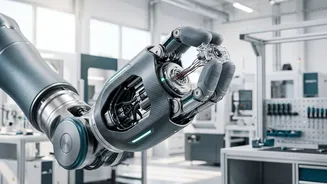
What makes Eka's approach different is its 'Vision-Force-Action' (VFA) model. Most robots rely heavily on vision, but Eka’s technology integrates sight with a sense of touch through advanced force sensors in its grippers. This allows the robots to develop an 'intuition' for physics, enabling them to feel when a grip is slipping or how much pressure to apply to a delicate object. Instead of being trained by mimicking human actions, Eka's robots learn through trial and error in massive-scale physics simulations. This reinforcement learning approach allows them to generate thousands of hours of experience in minutes, making the transition from simulation to real-world application more seamless and effective.
Scaling Customer Deployments
A primary goal for the new funding is to accelerate customer deployments. Eka is already testing its technology with several industrial clients, focusing on tasks like picking objects and handling wires. The robots have demonstrated remarkable performance, capable of picking around 1,500 objects per hour—more than double the average human rate of 600—with over 95% accuracy. They can handle a variety of objects without needing to be retrained for each new item. 'Scaling deployments' means moving these robots from pilot programs to full-scale commercial operations in factories, warehouses, and logistics centers, proving their value and reliability in sustained, real-world environments.
The Bigger Picture for Indian Robotics
While Eka is a US-based company, its success is part of a global surge in robotics and automation that has significant implications for India. The Indian industrial robotics market is expanding rapidly, with the country ranking seventh globally in annual robot installations in 2023. The market was valued at over $2 billion in 2026 and is projected to grow at a compound annual growth rate of over 15%. This growth is driven by automation in key sectors like automotive, electronics, and logistics. As Indian industries look to increase efficiency and competitiveness through Industry 4.0 initiatives, the demand for advanced, flexible robotic solutions like those being developed by Eka is set to soar. Breakthroughs in general-purpose robotics could unlock automation for countless tasks that are currently beyond the reach of traditional, single-purpose machines.