


Cosmic Clouds: The Stellar Nurseries
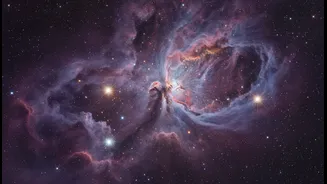
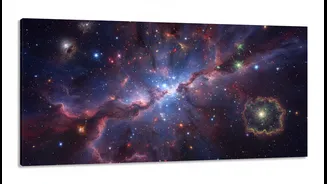
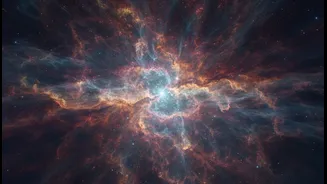
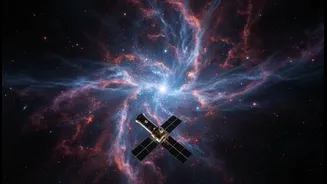
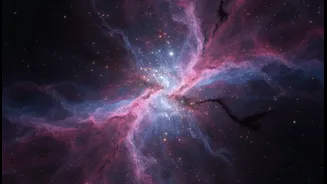
Every star begins its life within a vast, cold cloud of gas and interstellar dust known as a stellar nursery or molecular cloud. These regions, like the famous Orion Nebula or Carina Nebula, are the raw materials for stellar creation. For much of human
history, these were just fuzzy patches in the sky. But with Hubble’s powerful gaze, we can peer deep inside. Its ability to capture not just visible light but also infrared and ultraviolet wavelengths allows it to cut through the dense dust that would otherwise hide the action within. Images of these nebulae reveal incredibly complex landscapes of glowing gas and dark, dense pockets where gravity is beginning to pull material together into the seeds of new stars. It is in these dark, dusty cocoons that the entire process begins, hidden from less powerful telescopes.
Pillars of Creation: Birth and Destruction
Perhaps no image better illustrates star birth than Hubble’s iconic 1995 photograph of the Eagle Nebula, famously nicknamed the “Pillars of Creation”. These towering columns, stretching several light-years tall, are made of cool hydrogen gas and dust. They are a dramatic example of a stellar nursery in action. Within these dense pillars, gravity pulls clumps of gas and dust together, causing them to collapse and heat up, forming protostars. Hubble’s sharp images reveal that the tips of the pillars are particularly active, with newly formed stars shining brightly as they emerge from their dusty envelopes. The images also tell a story of destruction. The pillars are being eroded and sculpted by intense ultraviolet radiation and powerful stellar winds from a cluster of massive, hot young stars located nearby. This process, called photoevaporation, simultaneously creates the stunning pillar shapes while also dispersing the very gas needed for future star formation.
Protostars and Powerful Jets
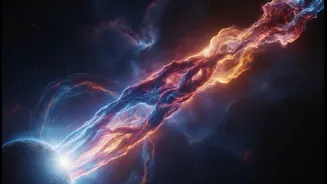
Once a clump of gas becomes dense enough, it forms a protostar—a hot, dense core that is not yet a true star because nuclear fusion hasn't started. Protostars are shrouded in thick dust, making them difficult to observe, but Hubble's infrared capabilities can penetrate the veil. These observations show a swirling disk of gas and dust, known as a protoplanetary disk, feeding the growing central object. This is the material from which planets will eventually form. One of the most dynamic stages of star birth involves the ejection of powerful jets of gas from the protostar's poles. These jets, known as Herbig-Haro (HH) objects, blast through space at supersonic speeds, some traveling hundreds of thousands of kilometres per hour. Hubble has not only taken still images of these jets but has also captured time-lapse movies, showing them moving and colliding with surrounding gas over several years, providing unprecedented insight into the chaotic final stages of a star’s birth.
The First Light of a New Star
The process of gathering mass can continue for millions of years, longer than some theories previously suggested. Throughout this period, the protostar continues to contract under its own gravity, causing its core to become hotter and denser. Eventually, the pressure and temperature reach a critical point—around 10 million degrees Celsius—and nuclear fusion begins. This is the moment a star is truly born. Hydrogen atoms start fusing into helium, releasing an enormous amount of energy that pushes outward, balancing the inward pull of gravity and creating a stable, shining star. Hubble has helped astronomers study huge populations of these newly formed stars in regions like LH 95 in the Large Magellanic Cloud. By observing thousands of stars at different stages of development side-by-side, scientists can build a clearer timeline of how stars mature and how different generations of stars can exist in the same nursery.