



A New Cosmic Mystery
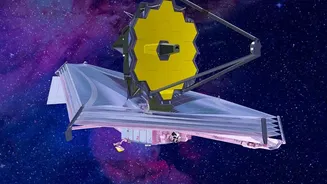
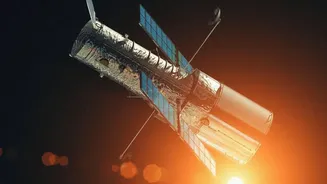
Since it began science operations, the James Webb Space Telescope (JWST) has been peering back to the dawn of time, capturing images of the universe as it was over 13 billion years ago. Amidst the familiar spirals and smudges of distant galaxies, astronomers
noticed a new class of object: compact, intensely red, and very, very far away. These 'little red dots,' or LRDs, appeared in large numbers around 600 million years after the Big Bang, a period of cosmic infancy. Initially, their existence was perplexing. Some theories suggested they were incredibly massive galaxies that had formed much faster than our models of the early universe allowed, earning them the informal nickname 'universe breakers'. Their sheer abundance and mysterious nature sent scientists scrambling to understand what they were truly seeing.
Peeling Back the Layers of Light
The leading hypothesis for a while was that these dots were extremely young galaxies, full of vigorous star formation and shrouded in thick dust, which would redden their light. However, as Webb’s powerful instruments gathered more detailed data, a different, more dramatic picture began to emerge. Using spectroscopy to break down the light from these objects, astronomers found tell-tale signs not of star birth, but of something far more violent. The evidence pointed towards the presence of actively feeding supermassive black holes, known as quasars or active galactic nuclei (AGN). The light signatures indicated gas swirling around a central black hole at tremendous speeds, a key indicator that these were not just placid, growing galaxies.
Challenging Black Hole 'Rulebook'
The discovery that many of these little red dots are powered by supermassive black holes has profound implications. According to our current understanding, black holes grow over billions of years by consuming gas, dust, and stars, or by merging with other black holes. Finding so many of these giants so early in the universe's history presents a major challenge. It suggests that some supermassive black holes must have grown 'too fast' or were formed through a different, more rapid mechanism than previously thought. In May 2026, a direct measurement of one such black hole, named QSO1, confirmed it was far too massive for its host galaxy, hinting that these black holes might have formed even before the galaxies that surround them.
An Exotic New Object: The 'Black Hole Star'?
This puzzle has led to more exotic theories. One of the most compelling is the 'black hole star' model. This theory proposes that LRDs are supermassive black holes wrapped in a vast, dense cocoon of gas. This gaseous envelope would be so thick that it would obscure many of the typical signals, like X-rays, that astronomers usually look for from active black holes. Instead of looking like a classic quasar, the object would glow like a star, powered not by nuclear fusion, but by the intense energy released from the black hole devouring the gas around it. Recent, deep observations of an LRD named GLIMPSE-17775 have provided strong evidence supporting this 'black hole star' scenario. This could represent a fleeting, transitional phase in the life of a galaxy, explaining why these red dots seem to disappear as the universe matures.