



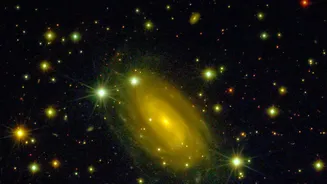
A Celestial Object with an Identity Crisis
Visible to the naked eye in the southern sky, Omega Centauri looks like a fuzzy star. For centuries, that’s what it was catalogued as. We now know it is a globular cluster, a massive, ancient sphere of stars tightly bound by gravity. Located about 17,000
light-years away, it’s the largest and most massive of the 150 or so globular clusters known to orbit our Milky Way galaxy. However, it has long been an oddball. Unlike typical globular clusters where all stars form at once, Omega Centauri contains multiple generations of stars with different chemical makeups. This has led many astronomers to suspect it’s not a cluster at all, but the captured core of a small dwarf galaxy that the Milky Way tore apart and absorbed billions of years ago.
The Case of the Missing Black Holes
The cluster's immense size and history created another puzzle. Based on its ten million stars, theoretical models predicted that Omega Centauri should be littered with thousands of stellar-mass black holes—the compact remnants left behind when massive stars die. Yet, for decades, astronomers couldn't find them. Previous searches looking for the tell-tale X-rays from material falling into a black hole came up empty. While evidence for a larger, intermediate-mass black hole at the cluster's very center had been found, the expected population of smaller ones remained stubbornly hidden, challenging theories of how stars evolve in such dense environments. Finding them required a different, more patient approach.
The Power of a 20-Year-Old Archive
The breakthrough came from combining old and new observations in a technique called astrometry, which involves precisely measuring the tiny movements of stars over long periods. A team of astronomers dug into more than two decades of archival data from the Hubble Space Telescope. This long baseline of observations, from 2002 to 2023, was crucial. By tracking the subtle wobble of a specific star over 20 years, they could deduce it was being pulled by an unseen, massive companion. To refine their measurements, they added recent, highly precise data from the James Webb Space Telescope. The combined data allowed them to map the star's path and confirm its partner was not a neutron star, but a black hole approximately 4.5 times the mass of our sun.
A Surprising Discovery Is Made
The newly found object, named oMEGACat BH-2, is the very first stellar-mass black hole confirmed in Omega Centauri. Its discovery, announced in July 2026, was full of surprises. The star and black hole orbit each other once every 94 years, the longest orbital period ever found for such a pair. This long, slow dance suggests the two didn't form together but found each other later in the cluster's crowded core. Furthermore, the black hole's mass is lower than expected for an object forming in this ancient, metal-poor environment, providing new clues and new questions for scientists modeling how black holes are born. The discovery was only possible because Hubble had been watching long enough to see the star's slow, gravitationally-influenced movement across the sky.