
A Festival Sweetened with Tradition
To understand Durga Puja in Kolkata is to understand its relationship with food. The festival is a grand homecoming, a city-wide celebration of community and culture that unfolds over several days. While elaborate savoury feasts and street-side snacks
like rolls and puchkas are integral, the soul of festive indulgence lies in its sweets. Mishti is not merely a dessert here; it is a language of joy, a sacred offering (prasad), and a gesture of hospitality. Every visit to a friend or relative's home is marked by the exchange of sweet boxes, and no auspicious news is shared without 'mishti mukh'—sweetening the mouth to celebrate a good beginning. During Puja, this tradition is amplified, with sweet shops working overtime and home kitchens bustling with activity. Within this vast universe of confections, Sandesh and Rosogolla stand as undisputed cultural icons.
Sandesh: The Elegant Emblem
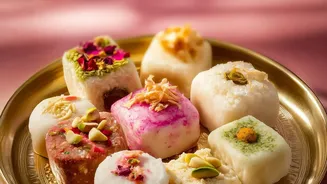
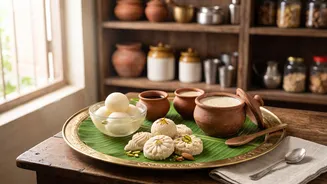
Sandesh is the more subtle and refined of the two. Made from fresh, finely kneaded cottage cheese (chhena) and sugar or jaggery, its origins are intertwined with the introduction of Portuguese cheese-making techniques in Bengal centuries ago. Unlike sweets made from khoa (milk solids) common in other parts of India, chhena-based sweets became a Bengali specialty. Sandesh represents artistry in confectionery. It can be soft and yielding (norom paak) or firm and dense (kora paak), and it is often moulded into beautiful shapes. During Durga Puja, it's a preferred offering to the goddess, considered pure and auspicious. Seasonal varieties, like those made with 'nolen gur' (date palm jaggery) in winter, are particularly cherished and align perfectly with the autumnal timing of the festival. It's the sophisticated sweet, a testament to the confectioner's skill and a symbol of classic Bengali taste.
Rosogolla: The Spongy Sphere of Joy
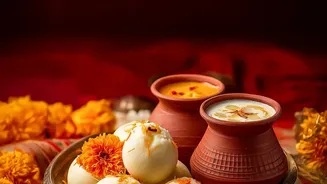
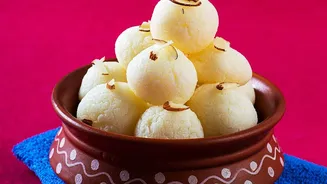
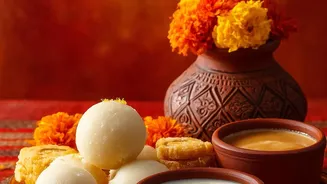
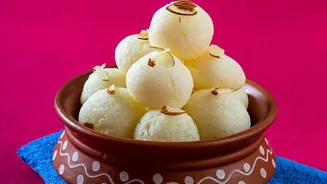
If Sandesh is refined art, Rosogolla is pure, unadulterated joy. These spongy, white balls of chhena boiled in a light sugar syrup are perhaps Bengal's most famous culinary export. While its origins were once a subject of a fierce debate with neighbouring Odisha, the 'Banglar Rosogolla' was eventually awarded its own Geographical Indication (GI) status, cementing its place in the state's heritage. The credit for the modern Rosogolla largely goes to confectioner Nobin Chandra Das, who perfected the recipe in 1868, creating a sweet that was accessible to everyone. Its universal appeal lies in its simplicity and delightful texture. During Durga Puja, Rosogolla is everywhere—served as part of the community feast (bhog), packed in tins for gifting, and enjoyed as a quick, refreshing bite while pandal-hopping late into the night. It is a democratic sweet, loved by all and symbolic of shared celebration.
More Than Just Desserts
So why these two? Their dominance comes from a blend of history, ritual, and emotion. Both are chhena-based, a style that defines Bengali sweet-making. They represent two sides of the same celebratory coin: the Sandesh as a refined, often homemade or artisanal offering, and the Rosogolla as a widely available symbol of hospitality and mass joy. They are central to the 'Subho Bijoya' greetings on the last day of the festival, when families and friends visit each other, embrace, and share sweets to mark the goddess's departure and look forward to her return. This act solidifies their role not just as food, but as facilitators of community and connection. Offering a Sandesh or a Rosogolla is an act of love, a gesture that says 'welcome' and 'let us celebrate together'.