








Task 1: Securely Access Your Results
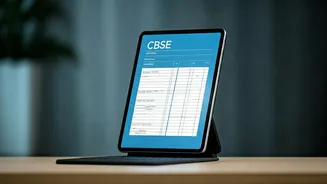
The first and most immediate task is to check your results. While numerous websites host the results, the most reliable sources are the official CBSE portals: results.cbse.nic.in and cbse.gov.in. However, due to heavy traffic, these sites can often crash.
A better, more stable option is DigiLocker. [16] The government's secure cloud platform not only provides your result but also hosts your official digital marksheet, which is legally on par with the physical copy. [3, 17] To access it, you will need to activate your DigiLocker account, a process that requires a 6-digit security PIN provided by your school. [3] It is advisable to complete this activation process even before the results are declared to ensure smooth access. [3] Once logged in, your marksheet and other important documents like the migration and pass certificates will be available in the "Issued Documents" section. [3, 4]
Task 2: Scrutinise and Verify Your Marksheet
Once you have downloaded your digital marksheet, the next task is to verify every detail meticulously. [11] Check your name, roll number, school details, and subject-wise scores for any discrepancies. This digital marksheet is crucial for all immediate university admission applications. [4, 11] While the physical copies will be dispatched to schools later, the DigiLocker version is accepted by universities across India for provisional admissions. [4, 11] If you find any error, you must contact your school or the concerned CBSE Regional Office immediately for correction. [3] Remember, DigiLocker only displays the data provided by CBSE and cannot make changes itself. [3]
Task 3: The Re-evaluation and Verification Option
If you are not satisfied with your marks, CBSE provides a structured three-tier process for redressal: verification of marks, obtaining a photocopy of your evaluated answer book, and finally, re-evaluation of specific answers. [4, 14] Recent updates show that CBSE has begun releasing re-evaluation and verification results in phases on DigiLocker. [6, 8, 10] For the 2026 results, the process allowed students to apply for scanned copies of their answer books first, before deciding on re-evaluation. [12, 23] It's important to note that re-evaluation does not guarantee an increase in marks; they can increase, decrease, or remain unchanged. [7] Students should stay updated via official CBSE circulars and avoid rumours on social media. [8, 10]
Task 4: Navigating University Admissions
For most students, the Class 12 result is a stepping stone to higher education. The next major task is managing university applications. For central universities, admission is no longer based solely on your board results but on your Common University Entrance Test (CUET) score. [26] Universities will soon release their own admission schedules and merit lists based on CUET scores. [26] However, your Class 12 score remains important. Many universities use it as an eligibility criterion (e.g., a minimum percentage) or as a tie-breaker if two students have the same CUET score. [26] You need to register on the admission portals of your desired universities, such as Delhi University's CSAS portal, and follow their specific procedures for seat allocation. [26] For professional courses like engineering and medicine, your JEE and NEET scores will be the primary determinants. [11]
Task 5: Collect Your Official School Documents
While the digital documents are valid for applications, you will eventually need the physical copies issued by your school. The final task is to stay in touch with your school to collect your original marksheet, transfer certificate (TC), migration certificate, and character certificate. [19] These documents are essential for finalising your admission at a university. Schools typically notify students when these documents are ready for collection, usually a few weeks after the results are declared. Keep all these documents safe as you will need them throughout your undergraduate journey and beyond.