




What Is Space Weather?
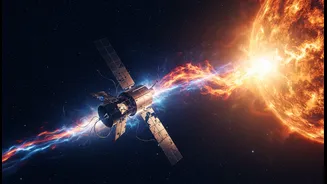
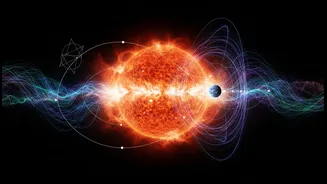
Space weather refers to the changing conditions in space, driven primarily by the Sun. Unlike weather on Earth, it doesn’t involve wind or rain. Instead, it consists of phenomena like solar flares (intense bursts of radiation) and coronal mass ejections
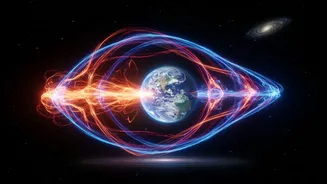
(CMEs), which are massive clouds of charged particles and magnetic fields hurled into space. When these solar storms head towards Earth, they can interact with our planet's magnetic field and upper atmosphere, creating geomagnetic storms. While these events are responsible for the beautiful auroras, they also pose a significant risk to the technology that powers our modern world.
Our Growing Web of Satellites
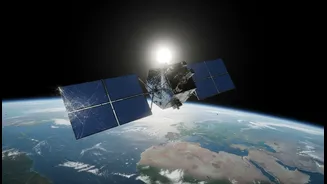
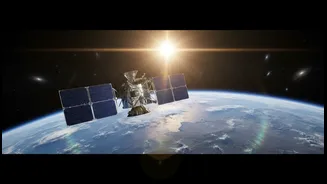
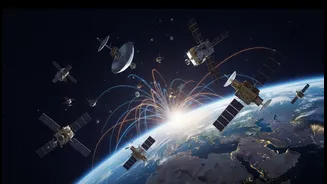
Until recently, the number of satellites in orbit was relatively manageable. Now, with the rapid deployment of 'mega-constellations' by companies like SpaceX (Starlink) and OneWeb, thousands of new satellites are being launched into low-Earth orbit (LEO). These networks aim to provide global internet coverage and other services, creating a dense web of technology circling the planet. This surge in satellite numbers dramatically increases our collective dependence on orbital systems for everything from communication and navigation to finance and defence. However, many of these new satellites were launched during a period of relatively calm solar activity, and their resilience to intense space weather is a growing concern.
How Solar Storms Wreak Havoc
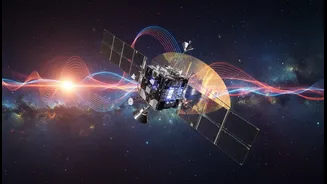
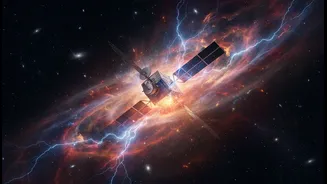
Space weather can harm satellites in several ways. During a geomagnetic storm, the Earth's upper atmosphere heats up and expands, increasing the atmospheric drag on satellites in LEO. This can cause them to lose altitude and, if uncorrected, even re-enter the atmosphere and burn up. In February 2022, a moderate solar storm was blamed for the loss of up to 40 newly launched Starlink satellites that couldn't overcome the increased drag. Beyond drag, energetic particles from solar storms can damage sensitive electronics, degrade solar panels, and cause 'phantom commands' that disrupt a satellite's operations. These storms can also disturb the ionosphere, the layer of the atmosphere that radio signals pass through, degrading the accuracy of GPS and other navigation systems like India's NavIC.
A Wake-Up Call for India
The threat is not abstract; it's already having an impact. In July 2026, it was announced that India's largest privately built Earth-observation satellite, Mission Drishti, was likely lost after being hit by a powerful geomagnetic storm just weeks after its launch in May. Developed by Bengaluru-based startup GalaxEye, the satellite encountered an anomaly that affected a critical onboard system, leading to a loss of communication. The incident served as a stark reminder of the vulnerability of even the most advanced spacecraft. While the company noted the mission provided invaluable engineering data for future, more resilient satellites, the loss highlights the urgent need for better space weather preparedness in India's rapidly growing private space sector.
The Race to Predict the Skies
Just as we have weather forecasts for Earth, agencies around the world are working to improve space weather prediction. Organisations like NOAA's Space Weather Prediction Center (SWPC) in the US and ISRO in India monitor the Sun for solar flares and CMEs, issuing watches and warnings. New observatories, like NOAA's SOLAR-1 which recently became operational, are positioned a million miles from Earth to get an advance look at the solar wind, providing a crucial, albeit short, warning of 15 to 60 minutes. In India, scientists are developing more accurate, region-specific models of the ionosphere to better predict disruptions to navigation and communication. Researchers are also leveraging artificial intelligence and machine learning to analyze data and improve forecast lead times, which could help satellite operators take protective measures like temporarily shutting down non-essential systems or adjusting orbits.