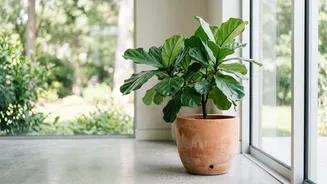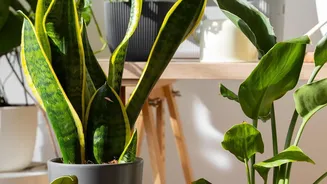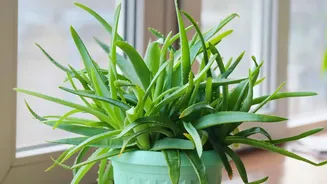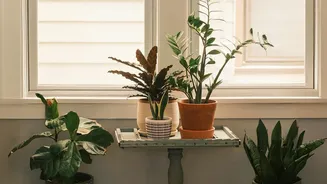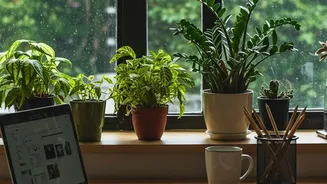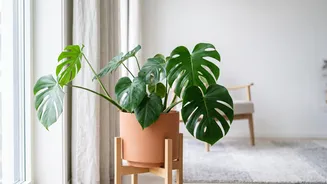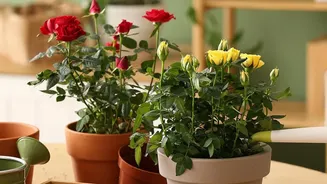





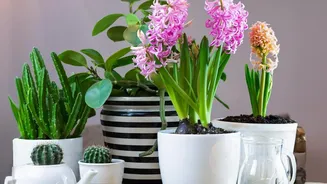
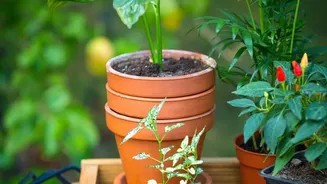
Have you noticed your favorite houseplant is starting to look a bit lopsided, leaning eagerly toward the window? This common behaviour is completely natural, but it can lead to uneven growth. Luckily, there's a simple fix: rotation.
The Science of the Lean
The reason your plant
cranes its neck toward a light source is a natural process called phototropism. Plants contain a growth hormone called auxin that promotes cell elongation. These auxins accumulate on the shadier side of the stem, causing those cells to grow longer and faster than the cells on the sunnier side. This differential growth results in the entire stem bending toward the light to maximise its energy absorption for photosynthesis. It’s a survival mechanism that helps plants find the sun, but indoors, it often results in a less-than-symmetrical appearance.
The Benefits of a Regular Turn
While an occasional lean isn't harmful, consistent one-sided growth can lead to a bare back and a heavy front. Regularly rotating your plants offers several key benefits beyond just aesthetics. It encourages balanced, symmetrical growth, resulting in a fuller, more robust plant. Stronger, more uniform stems develop when all sides of the plant have to support themselves. Furthermore, exposing all leaves to light ensures that the entire plant can photosynthesise efficiently, leading to better overall health and more vigorous growth. Improved air circulation around the entire plant is another advantage, which can help reduce the risk of pests and fungal issues that thrive in stagnant conditions.
Mastering the Rotation Routine
There is no single, perfect schedule for rotating plants, as it depends on your home’s lighting conditions. However, a simple and effective rule of thumb is to give your plant a quarter-turn each time you water it. This makes the habit easy to remember and provides consistent results. For plants in lower light, a turn every week or two might be beneficial, while those in bright, even light might only need it every few months. The key is consistency. Always turn the pot in the same direction to ensure a full, even rotation over time. If a plant already has a significant lean, you can correct it by turning the bare side to face the light, but do it gradually with quarter-turns to avoid shocking the plant.
When Not to Rotate Your Plants
Although rotation is a great general practice, it’s not a universal rule for every plant or situation. Some experts argue that constant rotation can create 'confused' growth and that letting a plant establish its 'front' side facing the light can be perfectly healthy. Certain plants, like orchids or Christmas cacti, should not be rotated once they have set their flower buds. Changing their orientation to the light source at this stage can cause stress and lead to the buds dropping before they bloom. Similarly, trailing plants like pothos or philodendrons often don't require rotation, as their natural growth habit is to cascade and spread out, and turning the pot might disrupt their flow. The takeaway is to observe your plant; if it looks healthy and full, there's no need to force a rotation schedule.
Fixing Issues Rotation Can't Solve
It’s important to recognise when a lean is a sign of a bigger problem that rotation alone cannot fix. If a plant is stretching with long, pale stems and sparse leaves (a condition known as etiolation), it is likely not receiving enough light. Simply rotating a light-starved plant will just encourage it to stretch from all directions, creating a weak and spindly shape. In this case, the solution is to move the plant to a brighter location. If a plant is topheavv, pruning or providing a support structure like a stake or trellis might be a better solution than just turning it. Rotation is a tool for shaping and balance, not a cure for poor placement or other care issues.