





A New Shape in the Southern Sky
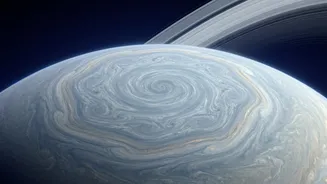
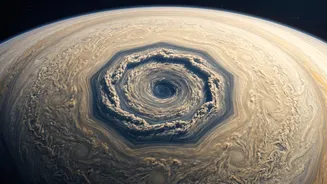
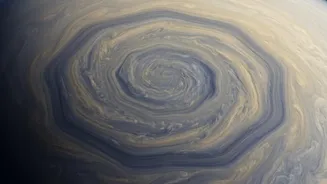
Scientists using NASA's Hubble Space Telescope have confirmed the existence of a massive, evolving, 10-sided atmospheric wave encircling Saturn's south pole. This feature, dubbed a decagon, marks the first time a large, regular-sided jet pattern has been
observed in the planet's southern hemisphere. The discovery came as a surprise because NASA's Cassini spacecraft, which orbited Saturn from 2004 to 2017, saw no hint of such a long-lived structure. It was only after Saturn's long season changed, tilting its south pole back toward Earthly view, that astronomers began spotting clues. Faint hints were first seen in 2023, with ground-based observations in 2024 adding more evidence, before Hubble's high-resolution images in 2025 confirmed the decagon's presence.
How is it Different from the Northern Hexagon?
While a sibling to the famous northern hexagon, the southern decagon is distinctly different. The hexagon at the north pole is a remarkably stable, six-sided pattern that has been observed for over 40 years. The southern decagon, however, appears to be a much newer phenomenon, seemingly having formed only recently. It is also located at a less polar latitude (around 63 degrees south) compared to the hexagon (around 78 degrees north). Furthermore, the decagon appears less robust; its shape seems to be strengthening and evolving, giving scientists a rare opportunity to watch a giant atmospheric pattern develop in real time. This has led to a central question: why did this 10-sided wave form now, when nothing similar had been seen before?
What Creates a Planetary Polygon?
These incredible geometric shapes are not solid structures but are actually bends in powerful jet streams—fast-moving rivers of air in the planet's atmosphere. On a gas giant like Saturn, with no solid landmasses to disrupt wind flow, atmospheric forces can create remarkably stable and symmetrical patterns. The leading theory involves phenomena known as Rossby waves, which form when rotating fluids drift across variations in latitude. Laboratory experiments have shown that by spinning a tank of liquid at different speeds, polygonal shapes can form in the turbulent area between the different flows. Scientists suspect the decagon is an atmospheric wave extending deep into Saturn, not just a feature on the cloud tops. Its winds are estimated to be moving at around 400 to 420 kilometers per hour.
The Search for an Answer
Researchers are now working to understand the trigger for the decagon's formation. One attractive hypothesis is that a nearby vortex or storm could have provided the initial disturbance that kicked off the wave. An anticyclone (a high-pressure vortex) was observed near the decagon's location, darkening just before the 10-sided pattern emerged, making it a plausible suspect. However, simulations have not yet been able to perfectly reproduce the observed decagon. Scientists also point out that while a similar vortex was once near the northern hexagon, that vortex disappeared while the hexagon remained, complicating the theory. Ultimately, the differences in the number of sides, latitude, and stability between the two poles remain a deep mystery.
Why This Discovery Matters
Studying these bizarre polar vortices provides a unique window into the physics of planetary atmospheres. They are natural laboratories for understanding fluid dynamics on a massive scale, free from the influence of oceans and mountains that complicate weather on Earth. The fact that the two poles on the same planet have generated such different, yet both polygonal, structures challenges existing models. By comparing the long-lived hexagon with the newly forming decagon, scientists can test theories about how such patterns are born and how long they can survive. This research not only deepens our understanding of Saturn's hidden interior and weather systems but also provides crucial insights that can be applied to the study of Jupiter's complex polar cyclones and the atmospheres of exoplanets beyond our solar system.