



The Orbital Junkyard
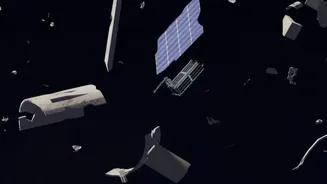
For decades, every rocket launch and satellite deployment has left something behind. Today, low Earth orbit (LEO) is cluttered with everything from defunct satellites and spent rocket stages to tiny flecks of paint and metal fragments from past collisions.
The European Space Agency (ESA) now tracks over 40,000 objects larger than 10 centimeters, but models estimate there are over a million smaller, untrackable pieces capable of causing catastrophic damage. Traveling at speeds exceeding 7 kilometers per second, even a small object can strike a functioning satellite with the force of a grenade, jeopardizing services we rely on daily, from GPS navigation to weather forecasting and global communications.
The Kessler Syndrome: A Cascade of Collisions
The primary fear among space agencies and satellite operators is a scenario known as the Kessler Syndrome. Proposed by NASA scientist Donald Kessler in 1978, it describes a tipping point where the density of objects in orbit becomes so great that collisions create a cascade of new debris, which in turn increases the probability of more collisions. This chain reaction could eventually render certain orbits unusable for generations, effectively trapping us on Earth. With the risk of collision in LEO having jumped significantly in recent years, the threat is no longer theoretical; it's an active and growing operational challenge.
A New Generation of Space Janitors
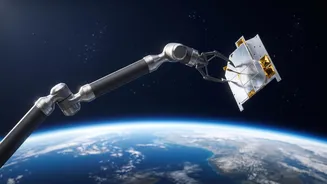
In response, a new commercial market for active debris removal (ADR) is emerging, with a projected value expected to reach into the billions. Companies like Japan's Astroscale and Switzerland's ClearSpace are pioneering technologies to capture and deorbit this dangerous junk. These missions are complex, requiring advanced robotics, autonomous navigation, and sophisticated rendezvous capabilities to approach and secure tumbling, non-cooperative targets. The goal is to turn clean-up from a series of one-off experiments into a routine and commercially viable service.
The Harpoon: A Classic Tool Reimagined
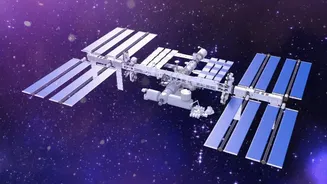
One of the most direct approaches involves a technology that's been in use for millennia: the harpoon. Companies like Airbus have been developing and testing harpoon systems designed to fire a tethered projectile into a large piece of debris, such as a derelict satellite. Once speared, the harpoon's barbs deploy to secure the target. The 'chaser' spacecraft can then use the tether to stabilize the object and pull it into a lower orbit where it will burn up in Earth's atmosphere. The RemoveDEBRIS mission, launched from the International Space Station, successfully demonstrated a harpoon test in orbit, proving the concept's viability for capturing large, uncontrolled objects.
Casting a Magnetic Net
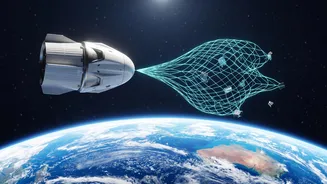
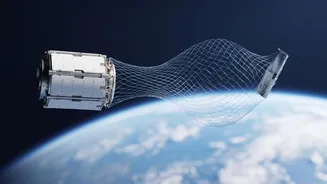
For other scenarios, magnetism offers a promising, less-impactful solution. Astroscale’s ELSA-d mission successfully demonstrated a magnetic capture system. This technology relies on a servicer spacecraft rendezvousing with a piece of debris that is either naturally magnetic or has been fitted with a ferromagnetic docking plate. By extending a magnetic mechanism, the servicer can attach to the target without the kinetic force of a harpoon, making it a gentler option for capture. Other concepts involve using powerful electromagnets to create a 'magnetic tug' that can influence and move debris without physical contact, or even deploying large nets with electromagnetic properties to sweep up multiple fragments.
Lasers, Claws, and the Road Ahead
Harpoons and magnets are just two of the technologies being developed. The ESA-commissioned ClearSpace-1 mission, slated to launch in 2028, will use a set of four robotic arms to embrace and capture its target. Meanwhile, researchers are also exploring the use of ground-based or space-based lasers. Instead of destroying debris, these lasers would heat a small spot on an object's surface, creating a tiny jet of vaporized material. This process, called laser ablation, would act like a micro-thruster, nudging the object into a different, safer orbit. While these technologies show immense promise, the challenges of cost, international regulation, and the sheer scale of the problem mean that cleaning up space will be a long-term, collaborative effort.