





What is Opposition?
In celestial terms, opposition is all about alignment. It happens when Earth passes directly between the Sun and an outer planet, like Saturn. Imagine the three bodies forming a straight line: Sun-Earth-Saturn. From our perspective on Earth, Saturn is on the opposite
side of the sky from the Sun. This perfect positioning means that as the Sun sets in the west, Saturn will be rising in the east. The planet will then travel across the night sky, reaching its highest point around midnight before setting in the west as the Sun rises. This alignment occurs for Saturn roughly once every year and provides the best opportunity for observation.
Bigger, Brighter, and Better
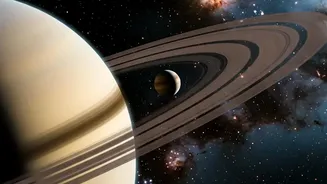
Opposition is the prime time for planet-watching for two key reasons. First, it marks the planet's closest approach to Earth for the year. For Saturn in October 2026, this means it will be approximately 1.26 billion kilometres away. While still incredibly distant, this relative closeness makes it appear larger and brighter in our sky than at any other time. Second, and more dramatically for telescope users, opposition triggers a phenomenon known as the "opposition surge" or the "Seeliger effect." Saturn's rings are made of countless icy particles that normally cast tiny shadows on each other. During opposition, the sunlight hits them from directly behind us, hiding these shadows and making the rings appear noticeably brighter for a few days around the event.
How to Spot Saturn
You don't need any special equipment to find Saturn. On October 4, 2026, and the nights surrounding it, look to the eastern sky after sunset for a bright, steady, yellowish point of light. Unlike stars, which twinkle, planets tend to shine with a more constant glow. Saturn will be bright enough to stand out, shining at a magnitude of about +0.3. This year, you can find it in front of the faint stars of the constellation Cetus, the Whale. An easy guidepost is to look below the large asterism known as the Great Square of Pegasus. While you can enjoy the sight with your naked eye, the real magic happens with a little magnification.
Do You Need a Telescope?
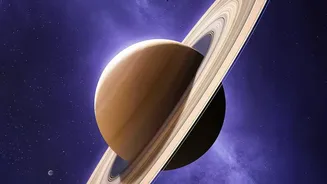
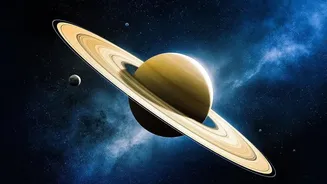
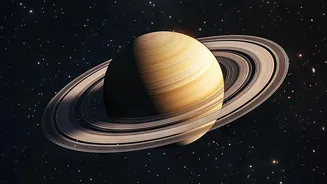
To see Saturn's famous rings, you will need optical aid. High-powered binoculars might give you a hint that the planet isn't perfectly round, but a telescope is what truly brings the spectacle to life. Even a small telescope with at least 50mm aperture and 25x magnification can reveal the rings as a distinct structure separate from the planet. A telescope with a larger aperture, around 4 to 6 inches, will provide a much clearer and more satisfying view, potentially even showing the gap between the rings known as the Cassini Division. After being nearly edge-on and invisible in 2025, the rings are once again tilted towards us in 2026, making this opposition a welcome return for one of astronomy's most iconic sights.
More to See This Month
Saturn isn't the only planet gracing the October sky. Mars and Jupiter will be spectacular sights in the morning, appearing as two bright 'stars' in the east before dawn. On October 6, a thin crescent Moon will pass very close to Jupiter, creating a beautiful pairing. For those with binoculars, Uranus is also visible, though it requires a bit more searching. October will also feature two meteor showers. The Draconids peak around October 8-9, and while they are minor, the nearly new moon means viewing conditions will be excellent. Later, the Orionid meteor shower, associated with Halley's Comet, peaks on October 21-22, promising faster and brighter meteors in the pre-dawn hours.