





An Orbit of Uncertainty
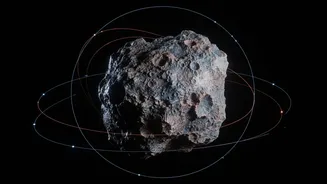
When astronomers first spot a near-earth object (NEO), they have very little information to work with—often just a few points of light moving against a background of distant stars. From these initial observations, they calculate a preliminary orbit. However,
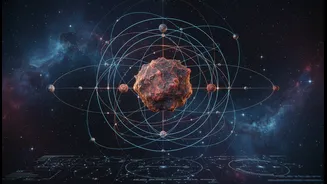
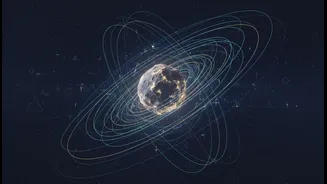
with so little data, this first trajectory is highly uncertain. Scientists represent this uncertainty as a large 'error ellipse' or 'risk corridor' in space. If Earth’s own orbit passes through this corridor, an impact is technically possible, leading to an initial risk estimate. This is why early probabilities can seem alarming; the zone of possibility is vast, and our planet is inside it. It’s not a prediction of doom, but a statistical flag that more observations are urgently needed.
The Power of More Data
To shrink that uncertainty, astronomers around the world get to work. They use ground-based telescopes and space observatories to gather more data points on the asteroid's position over days, weeks, and months. Each new observation helps refine the calculated orbit, making the 'error ellipse' smaller and smaller. In almost every case, this more precise path moves firmly away from a collision course with Earth. The risk probability drops to zero not because the asteroid changed its path, but because our understanding of its path became crystal clear. This collaborative, global effort ensures that no single agency is working in isolation, with data shared publicly via organisations like the Minor Planet Center.
ESA's Role in Planetary Defence
This is where the European Space Agency (ESA) and its specialised tools become critical. ESA's Near-Earth Object Coordination Centre (NEOCC), based in Italy, acts as a central hub for analysing asteroid data from across the globe. It uses a powerful suite of proprietary software, like the Aegis system, to independently compute orbits and monitor impact probabilities. The NEOCC maintains Europe's 'Risk List'—a catalogue of all objects with a non-zero chance of impact. Its experts coordinate follow-up observations and provide crucial risk analyses to scientific bodies and government agencies, ensuring that potential threats are monitored vigilantly. They also develop publicly accessible tools, like the Orbit Visualisation Tool, that allow anyone to see how these cosmic neighbours move through our Solar System.
The Case of Asteroid Apophis
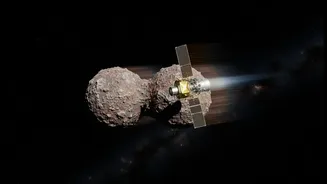
A perfect real-world example is the asteroid 99942 Apophis. When discovered in 2004, initial calculations showed a concerning 2.7% chance of it hitting Earth in 2029. This made it one of the most hazardous asteroids ever detected at the time. For years, astronomers collected more data. Additional observations ruled out the 2029 impact, and another in 2036, but a small possibility for 2068 remained. Finally, precise radar measurements in 2021 allowed astronomers to definitively rule out any impact risk from Apophis for at least the next 100 years, and ESA officially removed it from its Risk List. The story of Apophis perfectly illustrates the process: from initial alarm based on limited data to eventual safety confirmed by years of patient observation and analysis.