




Meet the Nancy Grace Roman Space Telescope
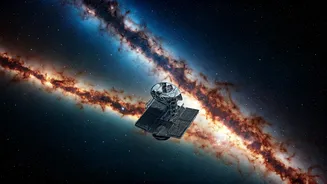
Its name might not be as famous as Hubble’s yet, but get ready to hear a lot about the Nancy Grace Roman Space Telescope. Scheduled for launch by May 2027, this next-generation observatory is NASA’s next great eye in the sky. Named after Nancy Grace Roman,
NASA’s first chief of astronomy, who was instrumental in getting the Hubble project off the ground, the telescope honours her legacy by pushing the boundaries of what’s possible. While Hubble is a general-purpose observatory and JWST is a super-sensitive infrared detective, Roman is a dedicated cosmic surveyor. Its mission is to tackle some of the biggest and most mysterious questions in astrophysics, including the nature of dark energy and the census of planets beyond our solar system. It’s equipped with a primary mirror the same size as Hubble’s (2.4 meters), but its technological package gives it a profoundly different, and powerful, capability.
The Power of a Panoramic View
The headline feature of the Roman telescope is its incredible field of view. This is what the “100-times wider” claim is all about. It doesn't mean the telescope itself is physically larger, but that the patch of sky it can capture in a single snapshot is 100 times greater than Hubble’s. Imagine you’re trying to study a massive, intricate mural on a wall. Hubble would be like looking at it through a drinking straw, forcing you to painstakingly stitch together thousands of tiny views to see the whole picture. Roman, by contrast, is like stepping back and taking a high-resolution photograph of a huge section of the wall at once. Its Wide Field Instrument (WFI) will capture images with the same crisp resolution as Hubble but over a vastly larger area. This will allow it to map the sky at a speed that was previously unimaginable, creating enormous cosmic maps that will serve as a treasure trove for astronomers for decades to come.
Hubble, Webb, and Roman: A Cosmic Trio
Calling Roman a “rival” to Hubble is a catchy way to frame it, but it’s more accurate to see it as a powerful new member of a team. Hubble, Webb, and Roman are designed to be complementary, each with its own strengths. Hubble primarily sees in visible and ultraviolet light, giving us the iconic, colourful images we know and love. JWST is its infrared successor, optimised to peer through cosmic dust and see the very first galaxies forming at the dawn of time. It excels at long, deep stares at tiny patches of sky. Roman also sees in infrared light, but its purpose is different. It’s a survey machine. Roman will rapidly scan vast swathes of the universe, identifying countless objects of interest—from new supernovae to strange star systems. Once Roman finds something intriguing, the sharper-eyed JWST can be pointed toward it for a more detailed investigation. In this way, Roman will act as a cosmic scout, generating new targets and questions for other telescopes to answer.
Hunting for Dark Energy and Rogue Planets
Roman’s wide-angle lens is perfectly suited for its two primary scientific goals. First, it will hunt for an explanation for dark energy, the mysterious force believed to be causing the universe to expand at an accelerating rate. By imaging billions of galaxies across cosmic time, Roman will measure their distances and distribution with unprecedented precision, allowing scientists to test theories about this cosmic acceleration. Second, Roman will conduct a massive galactic census of exoplanets. It will use a technique called gravitational microlensing, where the gravity of a star or planet bends the light of a more distant star, briefly making it appear brighter. This method is sensitive enough to find planets much smaller and farther from their stars than other methods, and it’s the only known way to find “rogue planets”—worlds that drift through space without a host star. Scientists expect Roman to discover thousands of new planets, fundamentally changing our understanding of how common they are in the Milky Way.