





Our Planet's Invisible Shield
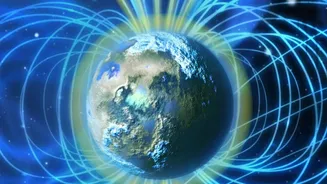
Deep within our planet, the churning of molten iron generates a massive magnetic field, creating a protective bubble called the magnetosphere. This field extends thousands of kilometres into space, shielding Earth from the constant stream of charged particles
flowing from the Sun, known as the solar wind. Without the magnetosphere, this solar wind would strip away our atmosphere, making life impossible. Think of it as Earth’s first and most important line of defence against cosmic radiation. This shield is not static; it's a dynamic entity that gets compressed on the side facing the Sun and stretched out into a long tail on the night side.
The Sun’s Turbulent Behaviour
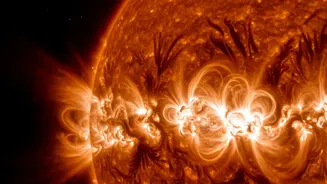
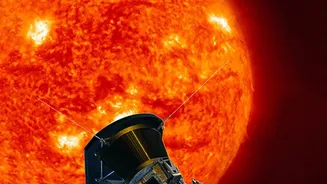
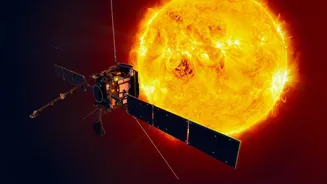
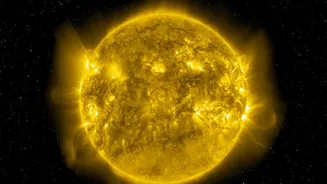
The Sun isn't always a calm, steady star. It has its own weather, driven by its complex and tangled magnetic fields. Sometimes, these magnetic field lines snap and reconnect, unleashing enormous bursts of energy, particles, and radiation. These events are known as solar flares and coronal mass cjections (CMEs). While a solar flare is a brilliant flash of light and radiation that reaches Earth in about eight minutes, a CME is a colossal cloud of magnetised plasma that travels much slower, taking one to three days to cross the space between the Sun and Earth. It’s these CMEs that pose the biggest threat to our planetary systems.
When Solar Storms Hit
When a CME slams into Earth's magnetosphere, it causes a major disturbance known as a geomagnetic storm. The CME's own magnetic field interacts with Earth's, transferring huge amounts of energy into our shield. This interaction causes rapid and significant fluctuations in the magnetic field on the ground. The most beautiful result is the aurora, the stunning Northern and Southern Lights, which occur when energetic particles are funnelled down magnetic field lines towards the poles and collide with atmospheric gases. But the effects go far beyond a pretty light show. These storms can wreak havoc on the technological infrastructure that underpins modern society.
The Global Tripwire
This brings us to why monitoring the magnetic field is so crucial. The fluctuations during a geomagnetic storm act as a planetary-scale tripwire. Ground-based instruments called magnetometers, located at observatories worldwide, continuously measure the strength and direction of the local magnetic field. When a CME arrives, these instruments detect the sudden changes, providing real-time confirmation that a storm is underway. This is not just an academic exercise. The data is a direct indicator of the storm's intensity and its potential to cause harm. For example, rapidly changing magnetic fields can induce powerful electrical currents in long conductors on the ground.
Protecting Our Modern World
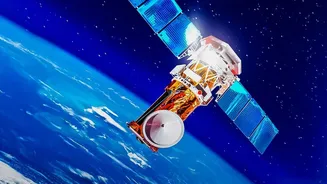
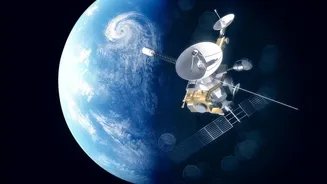
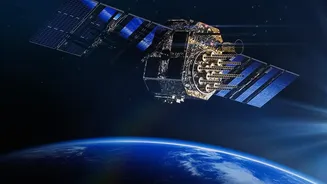
Those induced currents are bad news for our technology. They can surge through power transmission lines, overwhelming transformers and causing widespread blackouts, as happened in Québec in 1989. They can also accelerate the corrosion of oil and gas pipelines. In space, the increased radiation and atmospheric drag can damage satellite electronics, disrupt GPS signals, and interfere with communications. By tracking disturbances in the magnetic field, agencies like NOAA's Space Weather Prediction Center can issue timely alerts. These warnings give power grid operators time to take protective measures, satellite operators can put their spacecraft into a safe mode, and airlines can reroute flights away from polar regions where radiation is highest.