



How to Sail on Sunshine
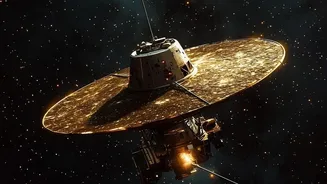
The concept of a solar sail sounds like something from a science fiction novel, but it is grounded in real physics. It works by capturing the momentum of photons—particles of light—streaming from the sun. Just as wind fills a sailboat's canvas, sunlight
exerts a tiny but continuous pressure on a large, reflective membrane. Each individual photon provides an almost immeasurably small push, but in the frictionless vacuum of space, the effect is cumulative. Unlike a chemical rocket that provides a powerful burst of thrust for a few minutes before its fuel is spent, a solar sail accelerates constantly. For weeks, months, or even years, this gentle, persistent push allows a spacecraft to build up staggering velocities, all without carrying a single drop of propellant. This eliminates the immense weight and cost of traditional fuel, opening the door for longer and more ambitious missions.
A Major Leap in Sail Technology
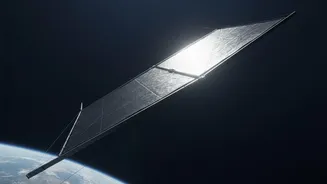
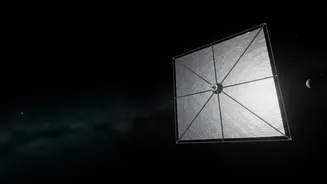
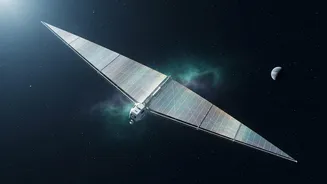
While the theory has been proven on past missions like Japan's IKAROS and The Planetary Society's LightSail 2, the headline-making progress comes from NASA's recent Advanced Composite Solar Sail System (ACS3) mission. Launched in 2024, the primary goal of ACS3 was not just to sail, but to test a critical new technology: its booms. These are the long, lightweight struts that deploy and hold the massive sail in place. The ACS3 mission successfully unfurled its 860-square-foot sail using revolutionary booms made of a lightweight composite material that is more resistant to the extreme temperature changes of space. While the spacecraft is having some issues with its control system, the successful deployment of these new booms was the crucial confirmation engineers were looking for. This test proves the viability of the structures needed to build much larger and more powerful sails in the future.
Redefining Deep-Space Speed
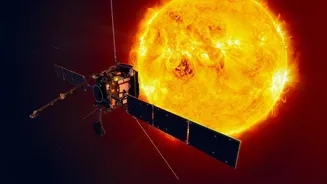
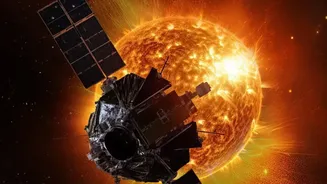
The phrase "extreme speeds" requires a change in thinking. A solar sail would lose a drag race to a conventional rocket leaving Earth. But the rocket burns out quickly, while the sail keeps accelerating. Over time, the sail-powered craft will not only catch up but blow past its chemically-propelled counterpart. Projections based on this technology are astounding. A concept known as Extreme Solar Sailing involves using a close pass of the sun as a gravitational and propulsive slingshot. This maneuver could accelerate a spacecraft to speeds over 300 kilometres per second. A journey to Jupiter that currently takes five years could be cut to just over a year. A probe could reach the edge of our solar system in a fraction of the time it took the Voyager missions. While even higher speeds, approaching a significant percentage of the speed of light, are theoretically possible, they would likely require a boost from powerful Earth-based lasers—a concept known as beam sailing.
The Next Generation of Exploration
The successful test of the ACS3 composite booms is already paving the way for what comes next. Building on this success, NASA has already awarded contracts to develop even larger systems. One such project aims to create a sail with an area of 1,600 square meters—roughly the size of an ice hockey rink and 20 times larger than ACS3. These next-generation sails will enable missions that are currently difficult or impossible. They could be used to position solar weather stations in unique orbits to give Earth more warning of dangerous solar storms. They are ideal for long-term reconnaissance of near-Earth asteroids or for delivering small satellites to the outer planets. By removing the constraints of fuel, solar sails give mission planners a new level of flexibility and endurance, enabling science that was once confined to the drawing board.