



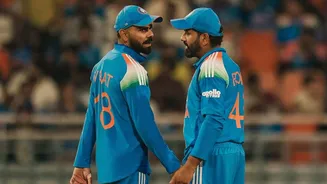
Setting the Scene: A Final Under Pressure
India, unbeaten throughout the tournament, walked into the Ahmedabad final as favourites. But the dream start quickly unravelled. After captain Rohit Sharma’s customary blitz gave India a flying start, his dismissal triggered a mini-collapse. Shubman
Gill and Shreyas Iyer fell cheaply, and at 81 for 3, the nation’s hopes rested on the partnership of Virat Kohli and KL Rahul. The Australian bowling, led by a tactically astute Pat Cummins, was relentless. The pitch was slow, making free-flowing strokeplay difficult, and the disciplined Australian fielding choked off easy singles, building immense pressure on the two men at the crease.
The Innings That Halted a Nation
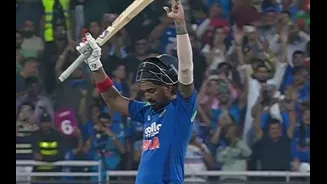
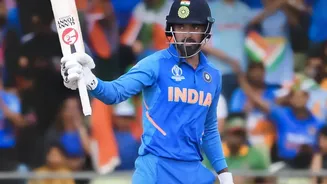
This is the crux of the argument against Rahul. He came in during the 11th over and was dismissed in the 42nd, batting for a significant portion of the innings. He ended as India's top-scorer with 66 runs, but those runs came off 107 deliveries. His strike rate of just over 61 was glaringly slow for a one-day international, let alone a World Cup final. The most telling statistic was the boundary count: Rahul hit just a single four in his entire stay at the crease. For a period of over 16 overs in the middle of the innings, India did not score a single boundary. While rebuilding was necessary after the early wickets, critics argue that Rahul's approach was far too defensive, allowing the Australian bowlers to dominate completely and stalling India's momentum.
Failure to Rotate and Accelerate
The partnership with Virat Kohli yielded 67 runs, but it came at a glacial pace, taking up 109 balls. Analysts noted that the inability to rotate the strike and pick up ones and twos created a logjam. Once Kohli was dismissed, the responsibility fell squarely on Rahul, as the last recognised specialist batsman, to anchor the innings and then accelerate. That acceleration never came. Instead of setting a platform for the lower order to launch from, his prolonged defensive batting meant the incoming batsmen like Suryakumar Yadav were under immediate pressure to hit out from ball one. Rahul himself admitted to regret, noting he was caught in two minds about whether to attack and ended up getting out at a crucial time when an extra 30-40 runs could have been decisive.
What About the Wicketkeeping?
While the headline points to 'poor wicketkeeping', this aspect of the criticism is less defined than the issues with his batting. Unlike a dropped catch at a critical moment, there were no single glaring errors from Rahul behind the stumps that directly cost India the match. He had a solid tournament with the gloves overall. The criticism in this area is often more abstract, bundled with the overall perception of his performance. Some critiques focused on a perceived lack of energy or proactivity, but the primary and most substantiated reason for the blame directed at him remains his ultra-cautious innings with the bat, which sucked the momentum out of India’s effort.
A Scapegoat or a Merited Target?
Is it fair to place the blame for a team's loss on one individual? The reality is more complex. The Australian team was exceptional on the day, with Travis Head playing one of the great World Cup final innings. Pat Cummins' captaincy and bowling were superb. The entire Indian middle order struggled to adapt to the slow surface after Rohit's aggressive start. However, in the anatomy of a defeat, the player who occupies the crease for the longest duration at the slowest pace inevitably becomes the focal point. KL Rahul's 107-ball vigil was seen not as a gritty fightback but as an innings that put immense pressure on his teammates and ultimately left India with a sub-par total that was simply not enough to defend.