







The Age-Old Pacing Dilemma
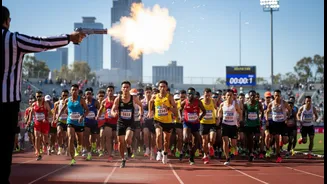
The first few kilometres of a marathon are a chaotic mix of adrenaline, excitement, and crowded courses. It’s incredibly easy to get swept up and run faster than you planned. The conventional wisdom has always been to start conservatively and avoid burning
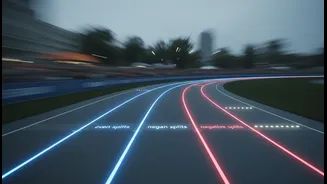
out too early. For decades, coaches have warned against the temptation of 'banking time' in the early stages, a strategy that often leads to hitting the dreaded 'wall' later in the race. This is when your body runs out of its primary fuel source, glycogen, leaving you to shuffle, walk, or even stop completely. Despite these warnings, studies show that a vast majority of recreational runners start too fast, a strategy known as a 'positive split,' where the second half of the race is slower than the first.
What the New Data Reveals
Recent large-scale studies have put hard numbers to these warnings, transforming coaching advice into concrete data. One major study published in the Journal of Sports Analytics examined over 1.7 million race results from recreational runners. The findings were stark: runners who started the first 5k just 10% faster than their average race pace ended up adding a staggering 37 minutes to their finish time. This happens because a fast start burns through your limited glycogen stores too quickly and can lead to a buildup of metabolites that increase fatigue. Essentially, you're taking out a loan your body can't repay in the final 10 kilometres. The data confirms that a fast start is the single biggest predictor of hitting the wall and having a miserable second half of the race.
Is Starting Too Slow Also a Mistake?
If going out too fast is a certified race-wrecker, the logical question is whether an overly cautious start is the answer. The same research provides a nuanced answer. The study found that starting the first 5k 10% slower than your mean race pace also carried a penalty, adding about 29 minutes to the average finish time. While less severe than the penalty for starting too fast, it shows that being excessively conservative can also prevent you from hitting your goal. You simply leave yourself too much time to make up. This suggests there is a 'Goldilocks' zone for your starting pace—not too hot, not too cold, but just right. The goal is to settle into a rhythm that is sustainable and close to your goal pace without expending unnecessary energy fighting crowds or surging with adrenaline.
The Gender Pacing Gap
Interestingly, recent research has consistently shown that women are generally more effective pacers than men. A recent study looking at over 870,000 finishers of the Berlin Marathon found that men are significantly more prone to aggressive starts and dramatic slowdowns. Among faster runners, men were up to six times more likely than women to 'hit the wall,' defined as slowing down by 20% or more in the second half. Researchers suggest this may be due to behavioural factors like overconfidence and greater risk-taking among male runners. Women, on the other hand, tend to adopt a more even or conservative starting strategy, which ultimately leads to a more consistent pace and a smaller drop-off in speed during the latter stages of the race.
Your Optimal Starting Strategy
So, what is the key takeaway for your next marathon? The science points overwhelmingly towards a controlled, disciplined start. For the first three to five kilometres, your goal should be to run at a pace that is slightly slower than your goal marathon pace. This allows your body to warm up efficiently, conserves precious glycogen stores, and keeps your heart rate from spiking. It's a strategy of patience. Resist the urge to weave through crowds. Settle into a comfortable rhythm and let the race come to you. Once the course opens up and you feel settled, you can gradually ease into your goal pace. The ideal strategy for most runners is an 'even split' (running the first and second halves in roughly the same time) or a slight 'negative split' (running the second half slightly faster). This approach is consistently linked with faster finish times and a much more enjoyable race experience.