


The Immediate Threat: A Lack of Pressure
The most immediate danger in space is not the cold, but the near-perfect vacuum. Here on Earth, the atmosphere exerts a constant pressure on our bodies, which is crucial for keeping our bodily fluids in a liquid state. Without that external pressure,
a grim process called ebullism would begin almost instantly. The boiling point of liquids drops dramatically, and the water in your tissues—your saliva, the tears in your eyes, and the fluids lining your lungs—would begin to vaporize. While your skin is elastic enough to prevent you from exploding like in the movies, your body would swell significantly. More critically, you would lose consciousness within about 10 to 15 seconds as the oxygen in your blood is depleted. If you tried to hold your breath, the air expanding in your lungs would cause them to rupture, sending fatal gas bubbles into your bloodstream.
A Tale of Two Temperatures
Space doesn't have a single temperature in the way we experience it on Earth. Without an atmosphere to distribute heat, temperature is a game of extremes dictated by sunlight. If you were floating in direct sunlight, you would be exposed to temperatures soaring up to 120°C (248°F). Conversely, if you were in shadow, such as the dark side of a spacecraft, you would face the chill of deep space, where temperatures can plummet to -100°C (-148°F) or even lower. However, you wouldn't freeze instantly. Since a vacuum is a great insulator, heat would leave your body slowly through radiation. You would succumb to the lack of oxygen long before freezing solid. The rapid evaporative cooling on moist surfaces like your mouth and nose could create frost, but this is a secondary concern.
An Invisible Barrage of Radiation
Earth's magnetic field and atmosphere act as a vital shield, protecting us from the constant stream of harmful space radiation. Outside this protective bubble, an astronaut would be exposed to intense levels of solar and cosmic radiation. This isn't like getting a sunburn; this radiation consists of high-energy particles that can shred DNA, damage cells, and cause severe long-term health issues, including an increased risk of cancer, cataracts, and degenerative diseases. While the fatal effects of radiation exposure are not instantaneous like depressurization, a large solar flare could deliver a lethal dose in a short period. A spacesuit is packed with layers designed to provide shielding from this invisible but persistent danger.
Impact from Micrometeoroids
The vacuum of space may be mostly empty, but it's not entirely devoid of matter. It's filled with countless tiny particles, ranging from dust grains to small rock fragments, called micrometeoroids. There is also a growing amount of man-made orbital debris. These particles travel at incredible speeds, many times faster than a bullet. Even a speck of paint can carry significant kinetic energy. While the odds of being hit by a larger object are low, a strike from even a tiny particle could easily puncture skin and tissue, causing serious or fatal injury. Spacesuits are designed with tough outer layers, often made of materials like Kevlar, specifically to protect against these high-velocity impacts.
The Spacesuit: A Personal Spacecraft
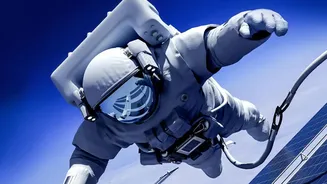
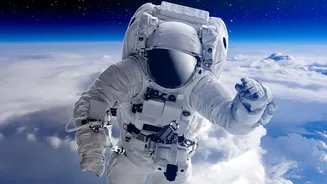
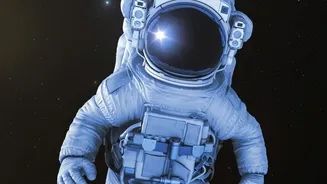
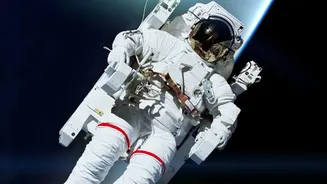
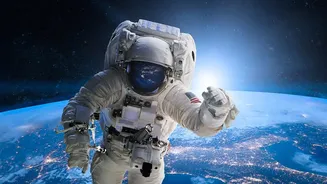
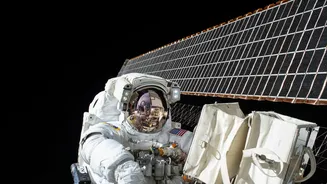
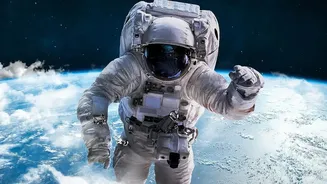
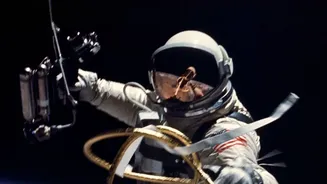
A spacesuit is far more than just a set of clothes. It's a marvel of engineering, essentially a personalized, human-shaped spacecraft. It provides a pressurized, oxygen-rich environment to prevent ebullism and allow for breathing. It contains sophisticated heating and cooling systems to regulate temperature against the extremes of sunlight and shadow. Its layers offer crucial protection from the constant bombardment of radiation and the potential impact of micrometeoroids. It supplies drinking water and a system for waste removal. Without every one of these functions working perfectly, human life in the vacuum of space would be impossible.