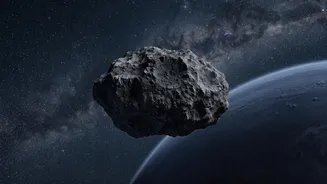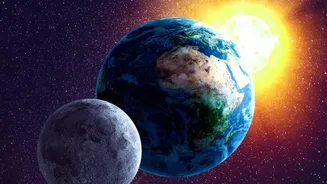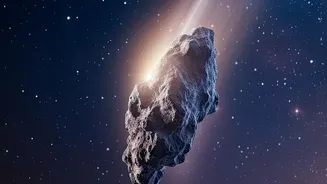

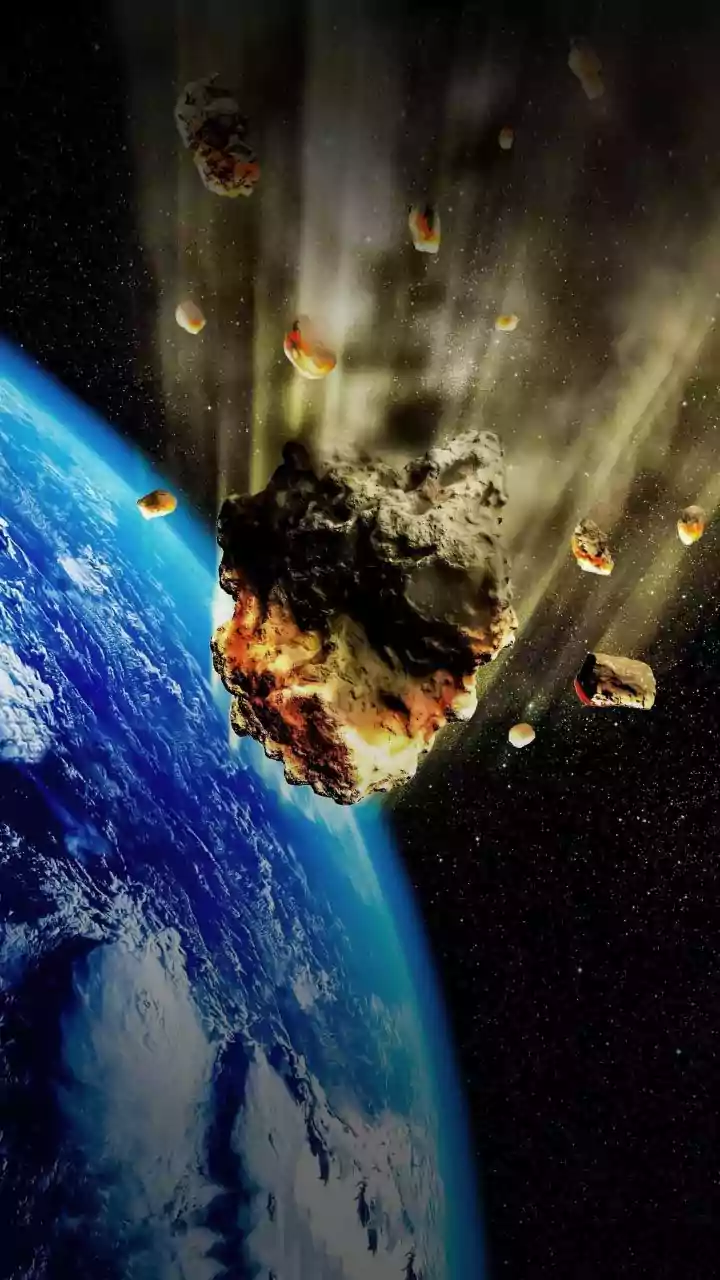

For a few fleeting months, Earth has had a secret companion. A tiny asteroid, caught in our planet's gravity, has been looping around us like a second moon. But its visit is ending, and it's preparing to say goodbye.
What Exactly Is a Mini-Moon?
Before you start planning for double
the moonlight, it’s important to understand that 'mini-moon' is an affectionate nickname, not an official astronomical term. These objects are technically known as Temporarily Captured Objects (TCOs). They are small asteroids or space rocks that, while orbiting the Sun, pass by Earth at just the right speed and angle to be ensnared by our planet's gravitational pull. Unlike our large, permanent Moon, these mini-moons have chaotic and unstable orbits. They might make a few loops around our planet over several months or even a few years before the complex gravitational dance between the Earth, Sun, and the object itself eventually flings them back out into space to continue their journey around the Sun.
The Brief Story of 2026 QQ8
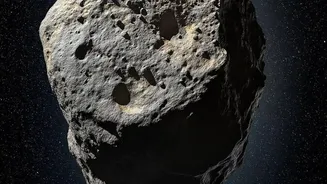
Our latest temporary companion, designated 2026 QQ8 by the International Astronomical Union's Minor Planet Center, is a perfect example of this phenomenon. Estimated to be only about two metres (around 6.5 feet) in diameter, it’s roughly the size of a large appliance. This tiny asteroid was first spotted in August 2026 by Hungarian astronomer Krisztián Sárneczky. However, orbital calculations show it was actually captured by Earth's gravity way back in April 2026. Initially, astronomers had to rule out the possibility that it was a piece of man-made space debris, like a defunct satellite part. After weeks of observation, its movement confirmed it was a natural rock, a tiny world on a temporary visit.
The Delicate Gravitational Dance
Getting caught by Earth isn’t easy. An asteroid needs to approach our planet at a relatively low speed and from the right direction. The combined gravitational forces of the Earth and our own Moon can then perturb its path, pulling it from a solar orbit into a complex, looping dance around our planet. These orbits are often highly elliptical and wobbly, a stark contrast to the stable, nearly circular path of our main Moon. At any given time, scientists estimate there is likely at least one mini-moon with a diameter of about one metre orbiting Earth, but their small size and faintness make them incredibly difficult to detect. Most are too small, too far, and move too fast for current surveys to easily spot them.
Why Is It Leaving and Where Is It Going?
The very same gravitational forces that capture a mini-moon are also responsible for its departure. The orbit of 2026 QQ8 is not stable. After several months of looping around us, its trajectory is carrying it away. Sometime in early December, it will pass a point where the Sun's gravity reasserts its dominance, and the asteroid will break free from Earth's grasp. It will then continue on its own independent orbit around the Sun, an orbit that happens to bring it close to Earth's path every so often. While its time as our moon is ending, this isn't the last we'll see of it. Its next close approach is predicted for 2058, though it will pass by at a much safer distance.
Can I See It?
Unfortunately, you won't be able to spot 2026 QQ8 with just your eyes or even a standard backyard telescope. The object is incredibly small and faint. Even at its closest, it will be much farther away than our main Moon and is roughly a million times dimmer than the faintest star visible to the naked eye. Its detection required powerful professional instruments, like those at the Lowell Discovery Telescope in Arizona and the University of Hawaii's Mauna Kea observatory, which were used to confirm its nature. While there’s no impact risk from 2026 QQ8, its small size means that even if it were on a collision course, it would likely burn up harmlessly in our atmosphere as a bright meteor.