




Reading an Atmosphere From Light-Years Away
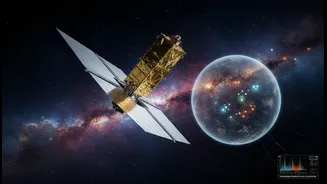
Finding water hundreds of light-years from Earth sounds like science fiction, but it relies on a clever technique called transmission spectroscopy. When an exoplanet passes in front of its host star from our perspective, a tiny amount of starlight filters
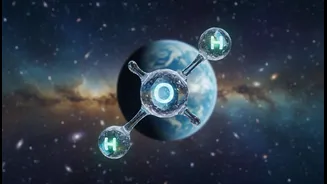
through the planet's atmosphere. Instruments like the Near-Infrared Spectrograph (NIRSpec) on the James Webb Space Telescope (JWST) can analyse this light. Different molecules absorb specific wavelengths, or colours, of light. Water vapour leaves a distinct and recognisable signature, essentially a chemical fingerprint that tells astronomers it is present, even across the vastness of space. This method allows scientists not just to confirm water's existence but to begin to understand the chemical makeup of these alien skies.
A Blueprint for a Planet's Birth
The amount of water detected in an exoplanet's atmosphere offers powerful clues about its origin story. Planetary systems form within a swirling disk of gas and dust around a young star. In this disk, there is a theoretical boundary called the "snow line." Inside this line, it is too hot for water to exist as ice, while outside of it, water is frozen. A planet that forms far from its star, beyond the snow line, is expected to be rich in water ice. If such a planet is later found orbiting much closer to its star, its water-rich atmosphere suggests it must have migrated inward over millions of years. Conversely, a rocky planet that formed close to its star might have a much drier atmosphere. By measuring the water content, scientists can essentially reconstruct a planet's journey and test theories about how planetary systems are built.
Beyond Water: The Full Chemical Story
While water is a star player, it is part of a much larger chemical cast. The JWST allows scientists to detect a range of molecules, including methane, carbon dioxide, and even sulfur dioxide. The ratios of these different elements, such as the carbon-to-oxygen ratio, provide an even more detailed picture of a planet's formation. For example, a recent study of the sub-Neptune exoplanet TOI-270 d detected methane and carbon dioxide, which, combined with evidence of water, helps refine models of its composition. However, researchers are now realising that the atmosphere they can see might not tell the whole story. Some models suggest that on certain planets, water could become layered, with much larger reservoirs hidden deeper below the observable atmosphere, meaning some worlds could be far wetter than they appear. This complexity is pushing scientists to develop more sophisticated models to interpret the data they receive.
Building a Cosmic Planetary Census
Each new detection adds a vital data point to our growing understanding of planets in the galaxy. By studying a diverse range of exoplanets—from hot gas giants like WASP-39 b to smaller, rocky worlds like LHS 1140 b—scientists can move from individual case studies to a broad, statistical understanding. This allows them to answer bigger questions: Are water-rich planets common? Do planets in a system with a red dwarf star evolve differently from those around a Sun-like star? The discovery of an atmosphere around LHS 1140 b, a rocky planet in its star's habitable zone, was a major milestone. It confirms that such planets can retain their atmospheres for billions of years, a key component for potential habitability. By compiling this census, researchers piece together the grand narrative of how planetary systems form and evolve across the cosmos.