



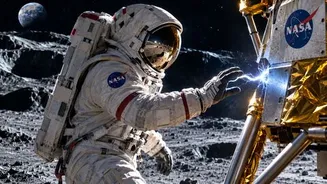
The Unforgiving Vacuum
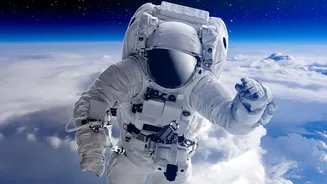
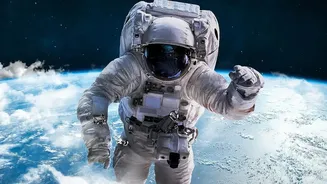
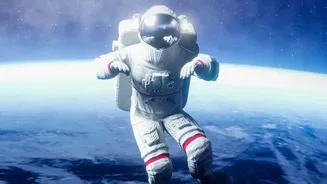
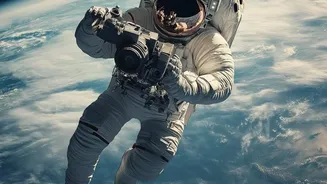
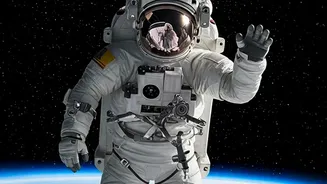
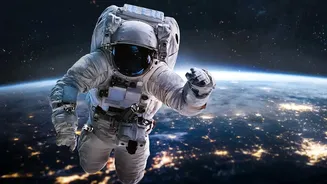
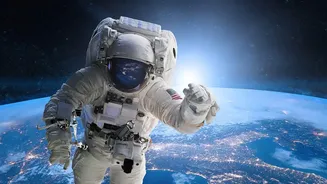
The most immediate and well-known danger of space is the near-perfect vacuum. On Earth, the air around us exerts constant pressure on our bodies. Without it, the human body undergoes a horrific process. Contrary to popular fiction, you wouldn’t instantly
explode. Instead, the first major problem is the lack of oxygen, leading to hypoxia. You would lose consciousness in about 15 seconds. At the same time, a grim phenomenon called ebullism would begin. The low external pressure causes the boiling point of liquids to drop. The water in your skin and blood would start to vaporize, causing your body to swell dramatically. While your skin is elastic enough to prevent you from bursting, the process would be catastrophic, causing massive tissue damage.
Extreme Hot and Cold
Space has no temperature in the way we understand it on Earth, as there is no air to hold heat. Instead, objects are heated by direct radiation from the Sun and lose heat when they are in shadow. This creates a world of brutal thermal extremes. An object in direct sunlight in Earth's orbit can reach temperatures of up to 120 degrees Celsius. In shadow, that same object can plummet to minus 160 degrees Celsius. Without a spacesuit's complex cooling and heating systems, an astronaut would either be cooked or frozen almost instantly, depending on whether they were facing the sun or floating in the Earth's shadow. These suits use layers of insulation and tubes of circulating water to maintain a stable body temperature.
An Invisible Barrage of Radiation
Here on Earth, our planet's magnetic field and atmosphere protect us from the constant stream of harmful radiation that permeates the cosmos. Outside this protective bubble, astronauts are exposed to high-energy particles from solar flares and deep-space galactic cosmic rays. This radiation shreds DNA, damages cells, and dramatically increases the long-term risk of cancer. Even a short exposure without protection could deliver a lethal dose, causing acute radiation sickness in a matter of hours or days. A spacesuit and the spacecraft's hull are designed with layers of materials specifically to absorb and deflect as much of this radiation as possible, but it remains one of the greatest long-term health risks for astronauts.
The Threat of Tiny Bullets
The vacuum of space is not entirely empty. It is filled with micrometeoroids—tiny particles of rock and metal from comets or asteroids—and an ever-growing cloud of orbital debris, which includes everything from flecks of paint to discarded satellite parts. While small, these objects travel at incredible speeds, often exceeding 28,000 kilometres per hour. At that velocity, even an object as small as a grain of sand carries the kinetic energy of a bowling ball. A direct impact from such an object could puncture a spacesuit, leading to rapid depressurization and all the fatal consequences of the vacuum. Spacesuits are therefore built with multiple layers, including an outer layer of tough, bullet-proof material like Kevlar, designed to shatter these tiny projectiles upon impact and protect the astronaut inside.