



A Steamy and Mysterious World
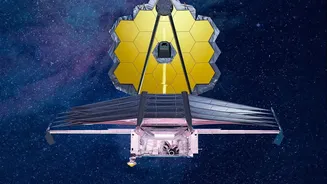
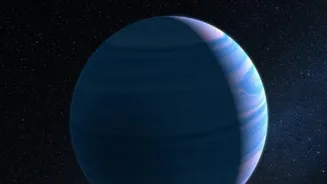
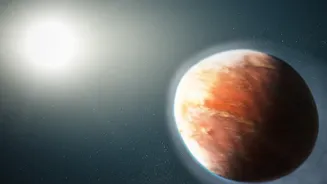
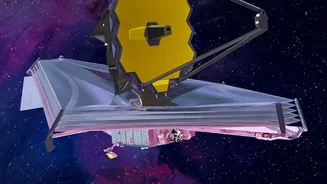
Scientists recently pointed the powerful eye of the JWST towards a fascinating exoplanet known as GJ 1214 b. Located about 40 light-years away, this planet is classified as a 'super-Earth' or 'mini-Neptune'—a world larger than Earth but smaller than Neptune,
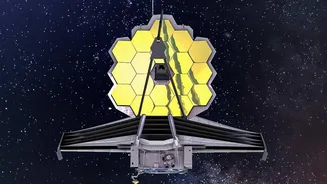
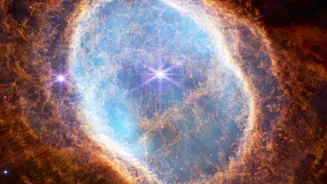
a type of planet curiously absent from our own solar system. For years, GJ 1214 b has been a source of frustration for astronomers because a thick layer of haze or clouds completely shrouded its atmosphere, making it impossible for older telescopes like Hubble to peek inside. But where Hubble saw an impenetrable veil, the JWST saw a challenge it was built for. Its ability to see in infrared light allowed it to finally pierce the clouds and analyse the composition of the atmosphere hidden beneath.
Seeing the Invisible with Infrared
The secret to JWST's success is its mastery of infrared light. This method, often called transmission spectroscopy, is like a cosmic chemical test. When a planet like GJ 1214 b passes in front of its host star—an event called a transit—a tiny fraction of the starlight filters through the planet's atmosphere. Different molecules in that atmosphere absorb specific wavelengths, or colours, of light. Water vapour, for instance, leaves a unique and recognisable 'fingerprint' in the infrared spectrum. By capturing this filtered starlight and splitting it into its component wavelengths, JWST's sensitive instruments can create a profile of the atmosphere, revealing which gases are present, even across quadrillions of kilometres of space.
What 'Water Vapour' Really Means
The detection of water is a monumental scientific achievement, but it doesn't mean we've found a lush, oceanic world. GJ 1214 b orbits its star very closely, completing a full year in just 1.6 Earth days. This proximity makes the planet incredibly hot, with surface temperatures far too high for liquid water to exist on the surface. The 'water' detected by JWST is in the form of steam, likely making up a significant portion of a thick, heavy atmosphere. In fact, some scientists theorise that GJ 1214 b could be a 'water world' that formed farther from its star with abundant water and ice, then migrated inwards, causing its oceans to boil off and form the steamy atmosphere we see today. So while you wouldn't be able to swim there, the discovery confirms that the building blocks of life are present in diverse planetary systems.
The Challenge of Confirmation
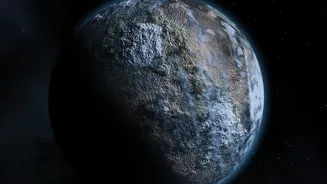
Science is a process of verification, and detecting atmospheres on rocky exoplanets is a cutting-edge field with unique challenges. In another case involving a super-Earth named GJ 486 b, JWST detected hints of water vapour, but scientists are cautiously working to determine its origin. The signal could be from a planetary atmosphere, or it could be coming from the cool spots on the host star itself, which can also contain water vapour. To be certain, astronomers plan to use multiple JWST instruments to observe the planet's 'day side'. If the hottest point of the planet is offset from the point directly facing the star, it would suggest an atmosphere is present and circulating heat—a key follow-up measurement that will help confirm these groundbreaking findings.
A New Era of Discovery
Each detection of water on an exoplanet, whether it's a hot super-Earth like GJ 1214 b or a gas giant like WASP-18 b, is more than just a single discovery; it's a proof of concept for the James Webb Space Telescope's incredible capabilities. These observations are helping scientists refine their theories about how planets form and evolve throughout the galaxy. While GJ 1214 b may not be habitable, the techniques used to profile its atmosphere are being honed for the ultimate prize: analysing the atmosphere of a truly Earth-like planet. With every new atmospheric profile, we move one step closer to answering one of humanity's oldest questions: are we alone in the universe?