


The Challenge of a Moving Target
From our perspective, the night sky appears to be a serene, unchanging dome. In reality, it's in constant motion. As the Earth spins on its axis, the stars, planets, and galaxies appear to drift across the sky. This movement is subtle to the naked eye
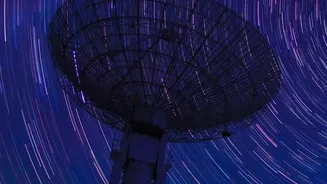
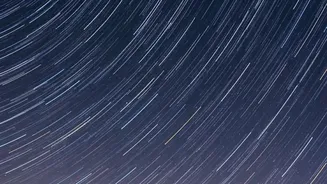
but becomes a major problem for photography. To capture the faint light from distant celestial objects, photographers need to use long exposures, leaving the camera's shutter open for seconds or even many minutes. On a standard, stationary tripod, this motion causes stars to appear as trails or arcs, smudging the fine details and ruining the shot. Even exposures of a few seconds can show blurring, especially with a telephoto lens.
Standard Tripods vs. Equatorial Mounts
A typical camera tripod has an 'alt-azimuth' mount, which means it moves up-and-down (altitude) and left-and-right (azimuth). While perfect for landscape or portrait photography, this two-axis movement is clunky for tracking stars. As celestial objects travel in an arc across the sky, an alt-az mount would need constant, complex adjustments in both directions to follow them. Even with computerized tracking, alt-az mounts introduce 'field rotation', where the object being tracked appears to slowly rotate within the frame, which will blur a long-exposure image.
The Smart Solution: Working with Earth's Rotation
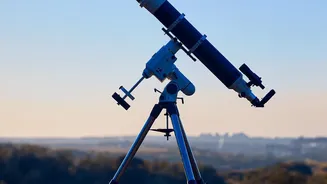
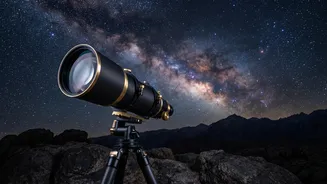
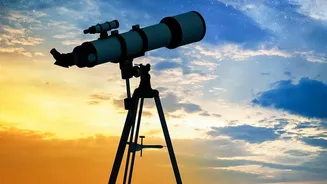
An equatorial mount solves this problem with ingenious simplicity. Instead of fighting Earth's rotation, it works with it. The mount has two axes of rotation, known as Right Ascension (RA) and Declination (Dec). The key is that the entire mount is tilted so its RA axis is parallel to the Earth's own axis of rotation. Once this alignment is done, the mount only needs to rotate along this single RA axis—at the exact same speed as the Earth, but in the opposite direction—to perfectly 'freeze' a star in the frame. This elegant, one-axis movement cancels out the planet's spin, making celestial objects appear stationary to the camera.
The Crucial Step: Polar Alignment
The magic of an equatorial mount only works if its primary axis is precisely aligned with the Earth's rotational axis. This process is called 'polar alignment'. For photographers in the Northern Hemisphere, this means pointing the mount's Right Ascension axis directly at Polaris, the North Star, which is located very close to the north celestial pole. In the Southern Hemisphere, a fainter star near the south celestial pole is used. This alignment is the most critical part of the setup. Most mounts include a small polar scope to help make this alignment precise. The better the alignment, the longer and sharper your exposures can be.
Unlocking the Deep Sky
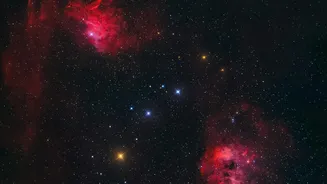
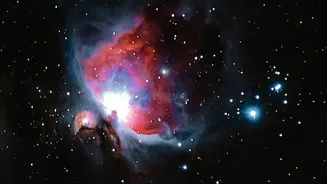
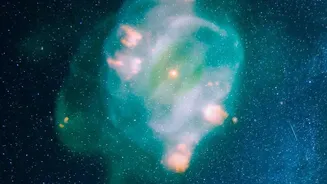
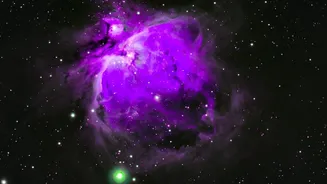
With a properly aligned equatorial mount, the possibilities for astrophotography expand dramatically. Photographers are no longer limited to exposures of a few seconds. They can keep the shutter open for several minutes at a time, gathering the faint photons from distant galaxies and colourful nebulae that would otherwise be completely invisible. This capability is essential for deep-sky imaging. Furthermore, it enables a technique called 'stacking', where multiple long-exposure shots are layered in software. Since the mount ensures every image is perfectly sharp and aligned, stacking them averages out random digital noise and enhances the faint details, resulting in a final image that is exceptionally clean, vibrant, and rich with cosmic detail.