



A Sweet Discovery in a Cosmic Cloud
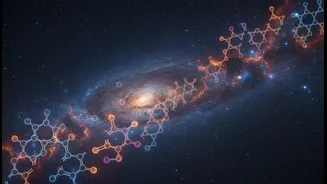
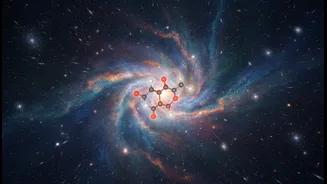
Astronomers have detected erythrulose, a four-carbon sugar, swirling in a massive cloud of gas and dust near the center of the Milky Way. While this may sound like a minor finding, it’s a landmark moment for astrobiology—the science of life's origins
and its potential existence elsewhere in the universe. On Earth, erythrulose is a natural sugar found in red raspberries and is even used in some self-tanning lotions. But finding it in the interstellar medium—the thin material that fills the space between stars—confirms that the key ingredients for life can form in the cosmos long before planets are even created.
How to Find a Sugar 27,000 Light-Years Away
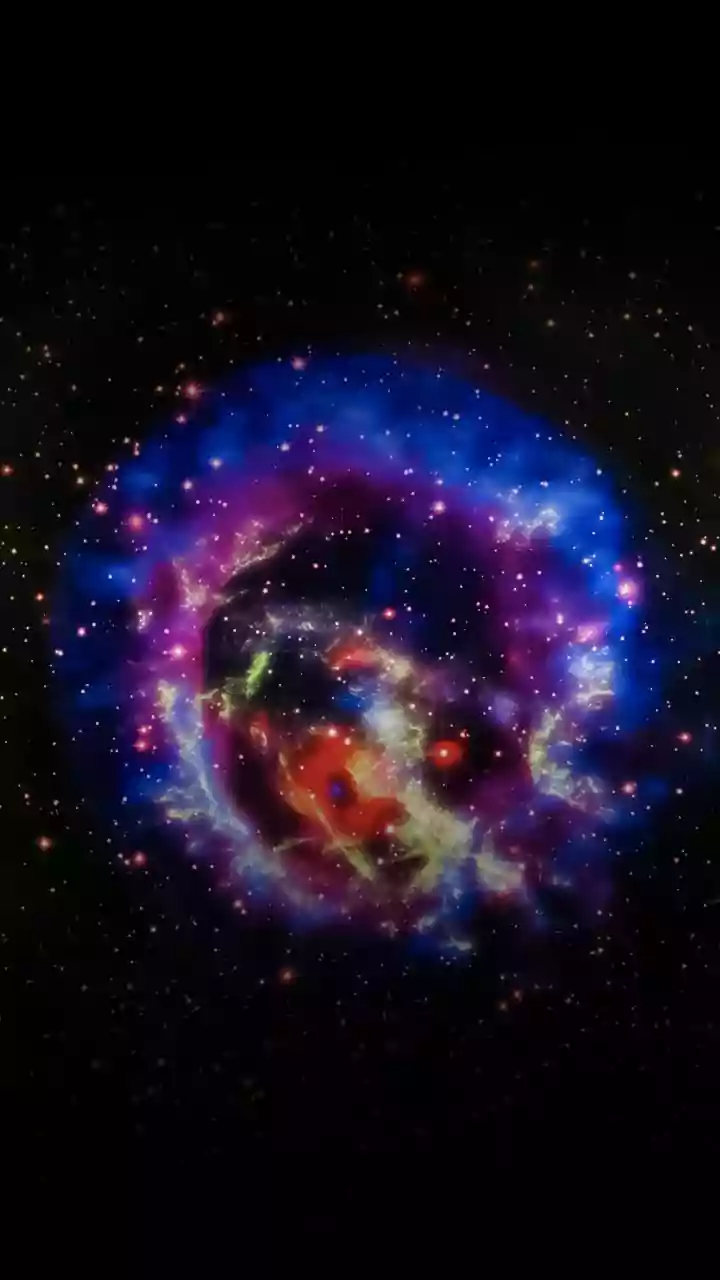
You can’t exactly take a sample from a gas cloud thousands of light-years from Earth. Instead, scientists used powerful radio telescopes in Spain to listen for faint electromagnetic signals coming from a specific molecular cloud called G+0.693-0.027. Every molecule vibrates and rotates at specific frequencies, creating a unique spectral “fingerprint.” By pointing their telescopes at the cloud, a team led by researchers from Spain's Centre for Astrobiology captured these faint signals. They then compared this data to the known signature of erythrulose measured in a laboratory on Earth and found a perfect match. This technique has been used to identify over 180 different molecules in space, but finding a true sugar like erythrulose is a major step forward.
More Than Just a Sugar
So, why does this particular sugar matter so much? Sugars are fundamental to life as we know it. They are not just for energy; a five-carbon sugar called ribose forms the backbone of RNA (ribonucleic acid), a molecule essential for carrying genetic information and building proteins in our cells. While erythrulose itself is not a direct component of RNA or DNA, it is a closely related chemical cousin. It is what scientists call a prebiotic molecule—a chemical precursor that could lead to the formation of more complex, life-sustaining compounds. The discovery suggests that if simple sugars like erythrulose can form in space, then it’s more plausible that complex sugars like ribose can too.
The Cosmic Recipe for Life
This finding adds a crucial ingredient to the known cosmic recipe book. For decades, scientists have wondered if the building blocks of life formed on a young Earth or if they were delivered from space. The discovery of complex molecules on meteorites and asteroids, like those from the asteroid Bennu, hinted that the ingredients came from the cosmos. The detection of erythrulose in the interstellar medium reinforces this idea. It suggests that the raw materials for life are not rare. They are created naturally in the vast factories of molecular clouds, which are the birthplaces of stars and planets. These ingredients could then be incorporated into comets and asteroids, which later rain down on young planets, seeding them with the potential for life to begin.
What Happens Next?
The discovery of erythrulose has opened a new door for astronomers. The immediate next step is to search for other, more complex sugars in space, especially the life-critical ribose. Finding these molecules would provide even stronger evidence that the universe is hard-wired for life. Researchers also want to understand how these sugars form and transform in the harsh environment of space. The presence of erythrulose near the galactic center means that similar molecules are likely hiding in other star-forming regions across the galaxy. As telescopes become more powerful, scientists expect to find more of these vital ingredients, painting an ever-clearer picture of our own cosmic origins.