








What Exactly Are Optical Skyrmions?
First conceptualized in the 1960s for particle physics, skyrmions are incredibly stable, particle-like topological patterns. Think of them as tiny, self-contained whirlpools that don't easily unravel. While first observed in magnetic materials, scientists
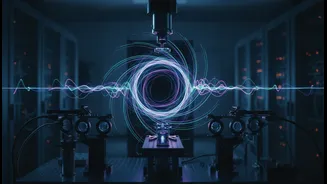
have recently managed to create their equivalent using light, giving rise to the 'optical skyrmion'. These are essentially nanoscale swirling patterns in a light field, where properties like polarization and phase are twisted into a robust, knot-like structure. Their stability is their superpower; unlike a simple beam of light that dissipates, a skyrmion's topology protects it from disturbances, making it an ideal candidate to carry information.
The Billion-Dollar Promise
The excitement around optical skyrmions is rooted in their potential to overhaul data technology. Researchers see them as building blocks for future data storage, communications, and computing. Because they are tiny and stable, they could be used to encode information, leading to data storage devices with unprecedented density. Imagine fitting an entire data center onto a device the size of a coin. Furthermore, since they are made of light, they can be manipulated at high speeds, promising optical processors that are significantly faster and more energy-efficient than today's electronics. Their applications could span from super-resolution imaging that bypasses the normal limits of light to fundamentally new types of quantum computing, where their inherent stability could solve major challenges in maintaining quantum states.
The Experimental Reality Check
Herein lies the risk mentioned in the headline. For all their promise, optical skyrmions are, for now, a laboratory phenomenon. The concept has only emerged in recent years, with a handful of research groups worldwide exploring its potential. Creating and controlling them is an immense challenge. Early methods relied on complex and expensive engineered metamaterials or bulky lab equipment like spatial light modulators. Researchers often need to generate them under very specific conditions, such as using evanescent fields on the surface of gold or within liquid crystals. While recent breakthroughs have shown simpler ways to generate them—one team in Singapore recently used a 200-year-old technique involving a laser and a small disc—these methods are still far from producing reliable, mass-manufacturable components. The work remains largely fundamental, focused on generating skyrmions and understanding their basic properties rather than building integrated devices.
A Familiar Story in Tech Hype
This gap between laboratory discovery and commercial product is a well-worn path in the world of materials science and physics. Graphene, for example, was hailed as a miracle material that would change everything from electronics to water filtration. While it has found niche applications, its widespread, revolutionary impact has been tempered by the immense engineering challenges of producing and integrating it at scale. Similarly, quantum computing has been 'just around the corner' for decades, with each breakthrough bringing it closer but also revealing new layers of complexity. Optical skyrmions are at an even earlier stage. The primary risk is not that the science is wrong, but that investors and industries, fueled by hype, will underestimate the long, arduous, and expensive journey of engineering required to translate these beautiful physics concepts into a product you can hold in your hand.
The Road from Lab to Laptop
For optical skyrmions to become practical, scientists must overcome several major hurdles. A key goal is finding ways to generate and control them on demand, at room temperature, without bulky and expensive equipment. Researchers are exploring the use of metasurfaces—ultrathin engineered surfaces—and specialized optical fibers to create more compact and integrated skyrmion generators. Another challenge is learning to manipulate them with precision, essentially 'writing' and 'reading' the information they might carry. This includes controlling their trajectory, as some recent experiments have shown they can be made to accelerate along a curved path. Each of these steps requires deep, fundamental research and patient, long-term investment in both the science and the engineering that will follow.