




The Fiery Challenge of Arrival
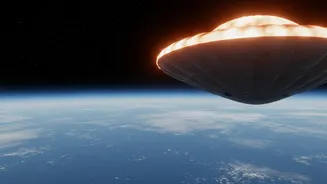
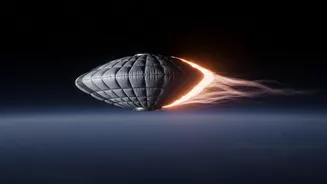
One of the biggest hurdles in space exploration isn't leaving Earth, but arriving somewhere else. When a probe enters a planet's atmosphere at hypersonic speeds—many times the speed of sound—the friction with the air generates immense heat and pressure.
To survive this plunge, spacecraft rely on heat shields, or aeroshells. For decades, these have been rigid, solid structures. The problem is that their size is limited by the dimensions of the rocket fairing that carries them into space. This limitation creates a bottleneck, restricting the weight and size of payloads we can land on planets like Mars, which has an atmosphere just thick enough to be a problem but too thin to slow things down easily.
A Revolutionary Solution: The Inflatable Shield
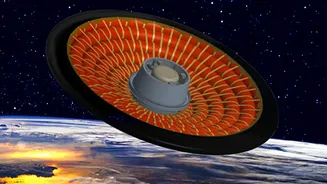
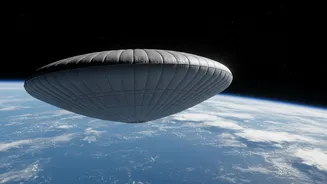
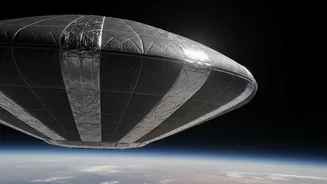
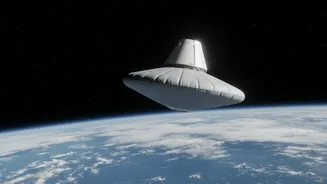
Enter the inflatable heat shield, officially known as a Hypersonic Inflatable Aerodynamic Decelerator (HIAD). Instead of a rigid, heavy shield, imagine one that can be packed into a small volume for launch and then inflated like a giant, mushroom-shaped cushion just before atmospheric entry. This simple-sounding idea is a game-changer. An inflatable shield can be deployed to a diameter much larger than any rocket fairing, creating significantly more drag. This increased surface area acts as a massive brake, allowing the spacecraft to start slowing down much higher in the atmosphere, where the air is thinner and the heating less intense. The result is a gentler descent that is more efficient and can support much heavier payloads.
How Does It Actually Work?
The technology behind these shields is a marvel of material science. The inflatable structure itself is often a series of concentric rings, or tori, made from braided synthetic fibres that are, by weight, stronger than steel. This structure is then covered by a flexible thermal protection system. This isn't just one layer, but a sophisticated blanket woven from advanced ceramic fabrics and insulators. The outer layer, often made of a woven silicon carbide fabric, can withstand temperatures exceeding 1,600°C. Beneath it, layers of insulation protect the inflatable rings, which are filled with nitrogen or another gas to maintain their shape against the powerful aerodynamic forces. NASA's successful Low-Earth Orbit Flight Test of an Inflatable Decelerator (LOFTID) in late 2022 was a crucial demonstration of this technology, surviving re-entry speeds of nearly 29,000 kilometres per hour.
Unlocking the Solar System
The success of inflatable heat shields opens up a new frontier of mission possibilities. For Mars, it means we can land larger robotic explorers, more sophisticated scientific instruments, and eventually, the habitats and supplies needed for human missions. Because the shields allow for deceleration at higher altitudes, we can also access landing sites in mountainous regions that are currently unreachable. The applications extend beyond Mars. Missions to Venus and Saturn's moon Titan, both of which have thick atmospheres, become more feasible. Closer to home, the technology could be used to safely return large cargo from the International Space Station or even recover and reuse expensive rocket boosters, significantly lowering the cost of access to space. European organisations are also developing similar technology, like the ICARUS project, aiming to recover rocket stages.
From Test Flights to Future Missions
The LOFTID mission was the culmination of over a decade of research and development, including earlier sub-orbital tests like the IRVE series. Its huge success confirmed that the technology is ready for operational use on future missions. Following the successful test, where the 6-meter shield splashed down and was recovered in the Pacific Ocean, engineers have been analysing the vast amounts of data collected. This information is now being used to refine designs for even larger shields. The technology is scalable, meaning future versions could be tailored for specific missions, from returning manufactured goods from space to landing a fully-equipped human habitat on another world.