



The Elusive 'Ghost Particle'
Neutrinos are fundamental subatomic particles, so famously antisocial they rarely interact with any other matter. With almost no mass and no electric charge, trillions of them pass through you every second, having travelled from the Sun and distant cosmic
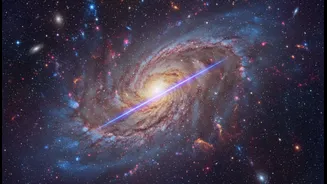
events without stopping. This ghostly nature makes them incredibly difficult to detect, let alone trace back to their source. The IceCube Neutrino Observatory, a massive detector buried a kilometre deep in the Antarctic ice, is designed for this very task. It watches for the faint blue flash of light, known as Cherenkov radiation, that occurs on the rare occasion a neutrino collides with an atom in the ice. On September 22, 2021, IceCube detected a particularly powerful event: a single neutrino, dubbed IC 210922A, carrying an energy of about 750 tera-electronvolts—hundreds of times more powerful than anything achievable in our largest particle accelerators.
A Cosmic Magnifying Glass
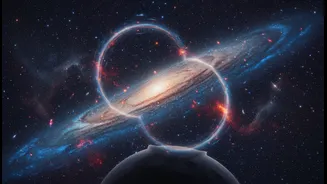
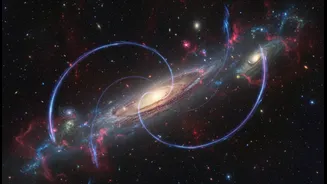
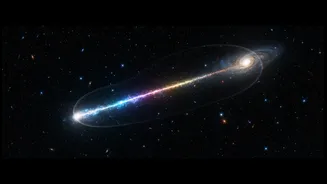
Pinpointing where IC 210922A came from was a monumental challenge. Alerts were sent to telescopes worldwide to scan the patch of sky the neutrino originated from, but initial searches for a bright, obvious source like an exploding star or a supermassive black hole came up empty. However, an international team led by researchers in Taiwan found a promising, if unusual, candidate. Using radio telescopes, they spotted a faint glow. Further observation with the powerful ALMA telescope revealed something incredible: the source wasn't just one galaxy, but two. A massive elliptical galaxy in the foreground was acting as a 'gravitational lens'—its immense gravity bending and magnifying the light from a much more distant galaxy directly behind it. This natural telescope, predicted by Einstein's theory of relativity, enlarged the image of the distant galaxy, allowing astronomers to study it in unprecedented detail.
Meet the 'Shadow Blaster'
The distant galaxy, nicknamed the 'Shadow Blaster', is a revelation. It is a dusty starburst galaxy seen as it was about 11 billion years ago, during a period of intense cosmic activity known as the 'Cosmic Noon'. Normally hidden from view by thick clouds of dust, this galaxy is a powerhouse of star formation. Initially, astronomers suspected a supermassive black hole was the engine creating such a high-energy particle, as has been the case with other neutrino sources. But the data showed no signs of black hole activity. Instead, the evidence pointed to the galaxy's own extreme environment. It features a compact, gas-rich core where intense star formation creates a natural particle accelerator. In this dense region, energetic particles collide with gas and dust, producing a shower of particles, including high-energy neutrinos.
A New Era for Particle Astronomy
This discovery marks a significant step forward for multi-messenger astronomy, a field that combines data from different cosmic 'messengers' like light, gravitational waves, and particles like neutrinos. It provides the strongest evidence to date that dusty, star-forming galaxies are a major, previously hidden source of the high-energy neutrinos that pepper the universe. While individual galaxies like the Shadow Blaster are weak neutrino emitters, as a population, these types of galaxies from the Cosmic Noon could be responsible for a significant portion of the total neutrino background that IceCube observes. More importantly, it demonstrates a new technique. By combining neutrino detection with the power of gravitational lenses, astronomers can now probe the most distant and dust-obscured corners of the universe, revealing the violent processes that have long been hidden from traditional telescopes.