
The Red Planet's Dinner Dilemma
Sustaining human life on Mars is far more complex than the journey there. A major hurdle for any long-term colony is creating a stable food supply. Resupplying from Earth is prohibitively expensive, meaning future Martians must achieve agricultural self-sufficiency.
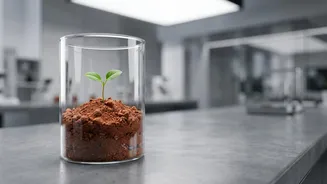
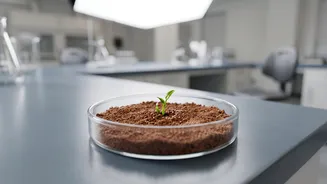
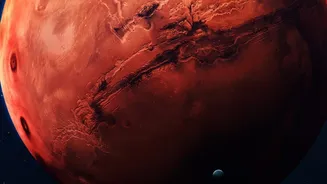
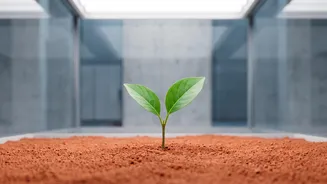
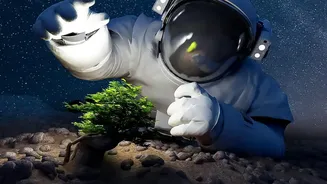
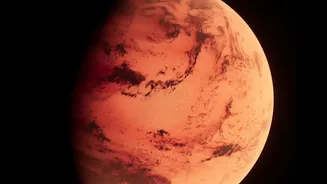
But Mars is not a welcoming place for farming. The planet's 'soil,' known as regolith, is a lifeless dust full of toxic compounds like perchlorates and devoid of the organic matter essential for plant growth. It is also exposed to intense cosmic radiation and extreme cold, with an average temperature of around -62 degrees Celsius. Any attempt at agriculture must happen within protected, controlled environments, creating a miniature Earth on a hostile world.
A New Generation of Cosmic Gardeners
This immense challenge has sparked innovation, particularly among students. Competitions like NASA's Deep Space Food Challenge have called on students, chefs, and small businesses to design novel food production systems for deep space missions. For example, a team of Texas students—Varshini Gandreddy, Dhiti Koyya, and Raaga Bukkaraju—developed a concept called 'Gaia's Outpost' for the Conrad Challenge. Their project focuses on processing the toxic Martian regolith to make it a viable growing medium. Similarly, a group of undergraduate students at Purdue University took on NASA's Plant Mars challenge, experimenting with growing soybeans in a simulated Martian soil, encountering firsthand the challenges of its toxic chemical composition. These student-led projects are not just academic exercises; they are tackling the core problems that space agencies need to solve for future missions.
From Hydroponics to Fungi
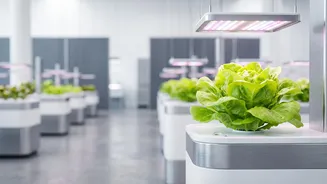
The solutions being explored are as varied as the challenges. Many concepts move away from traditional soil altogether. Hydroponics and aeroponics, methods of growing plants in nutrient-rich water or mist, are leading contenders because they use less water and space. Other futuristic ideas include using synthetic biology to engineer crops specifically for Martian conditions, improving their resistance to cold and radiation. Some researchers are looking at fungi and microbes to do the heavy lifting. Bacteria could be used to 'fix' nitrogen from the thin Martian atmosphere, creating natural fertilizer, a project Ph.D. student Mathangi Soundararajan is working on at Utah State University. Even more radical concepts involve creating food from waste streams. Some teams in the Deep Space Food Challenge have developed systems that turn human waste or even plastics into edible, protein-rich biomass.
More Than Just Calories
The goal isn't just to produce calories, but to provide safe, nutritious, and appealing food. A monotonous diet of nutrient paste would be bad for morale and health on a mission that could last for years. The psychological benefits of fresh food and the act of gardening are considered crucial for the well-being of astronauts living in an isolated and barren environment. Researchers are even exploring how to engineer plants that could provide medical benefits, such as producing an anti-inflammatory compound, to help astronauts stay healthy. This holistic approach ensures that the food system supports not just physical survival but also the mental fortitude required for deep space exploration.
Solutions for a Changing Earth
The incredible constraints of growing food on Mars are forcing a revolution in agricultural efficiency, and the benefits could be felt right here on Earth. Developing closed-loop systems that recycle water and waste with minimal inputs has direct applications for sustainable agriculture in our planet's harshest environments and dense urban centers. The work on making Martian regolith fertile could inform how we restore degraded soils on Earth. In a way, by solving for Mars, we are creating a blueprint for a more sustainable food future on our own planet, tackling issues of water scarcity, land use, and resource efficiency.