


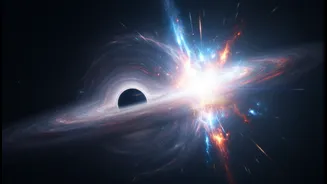


A Cosmic Giant Awakens
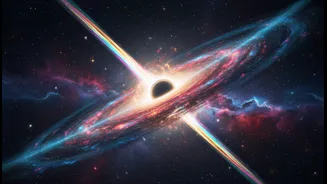
Deep in the cosmos, a galaxy named SDSS1335+0728, previously unremarkable, suddenly began to shine brighter than ever before in late 2019. Astronomers tracking this change concluded they were witnessing the awakening of the massive black hole at its core.
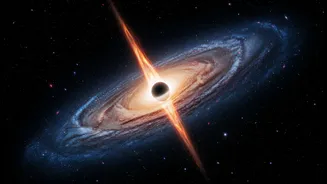
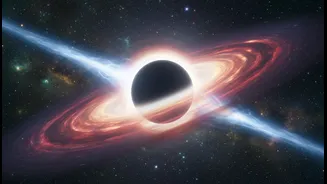
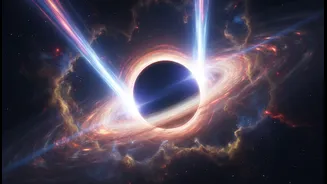
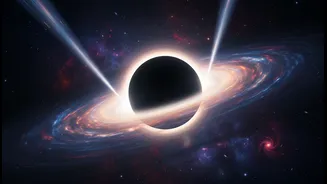
These cosmic monsters, often millions or billions of times the mass of our Sun, usually lie dormant and invisible. An awakening happens when a black hole starts to feast on a large supply of gas and dust from its surroundings. As this material spirals inward, it heats up and glows intensely, turning the quiet galactic center into a brilliantly luminous Active Galactic Nucleus (AGN). Catching this process in real-time is a first for astronomy, offering an unprecedented opportunity to study how these giants switch on.
Weighing the Unweighable
So, how do you weigh an object that's defined by its light-trapping gravity? Traditionally, astronomers had two main methods, both of which were slow and difficult. One way is to track the orbits of stars very close to the black hole over many years, or even decades. The stars' speeds reveal the strength of the gravity they are fighting, which in turn gives away the black hole's mass. Another method involves observing the collective motion of gas and stars in the galaxy's core. While effective for the local universe, these techniques provide a static snapshot and are incredibly challenging for distant galaxies. The recent awakening of SDSS1335+0728 provided the perfect laboratory for a much faster, more dynamic technique.
Reading the Dinner Plate
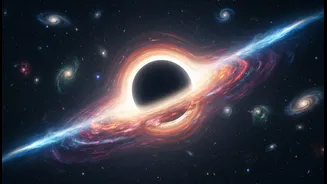
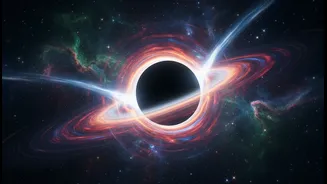
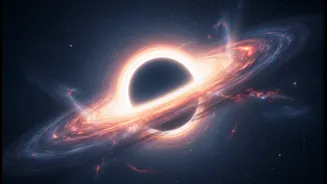
The key to the new real-time analysis lies in the swirling vortex of material being consumed by the black hole, known as an accretion disk. Think of it as the black hole's dinner plate. This disk doesn't just slide quietly into the abyss; it becomes a chaotic, superheated environment where friction and immense gravitational forces cause it to radiate an incredible amount of energy across the spectrum, from X-rays to optical light. For an active black hole, this accretion disk is the main event, sometimes outshining all the stars in its host galaxy combined. The brightness and characteristics of the light emitted from this disk hold the secrets to the properties of the central engine driving the spectacle—the black hole itself.
The Echoes That Betray Mass
The technique scientists are using is elegantly called reverberation mapping, which essentially uses light echoes to measure vast cosmic distances. Here’s how it works: The innermost part of the accretion disk, closest to the black hole, flickers randomly as it's consumed. This flash of light travels outward, illuminating gas clouds orbiting further away. This outer gas then lights up in response, creating a delayed “echo” of the original flicker. By measuring the tiny time delay between the initial flash and its echo, and knowing the speed of light, astronomers can calculate the physical distance between the black hole and the echoing gas cloud with remarkable precision. This technique cleverly substitutes time resolution for spatial resolution, which is impossible to achieve directly for such distant objects.
From Echoes to Mass
Knowing the distance is only half the puzzle. To get the mass, scientists also need to know how fast that echoing gas cloud is orbiting the black hole. They determine this by analyzing the color of the gas's light. As the gas moves, its light is stretched or compressed due to the Doppler effect—the same principle that makes an ambulance siren change pitch as it passes you. By measuring this color shift, they can calculate the orbital speed of the gas. With both the orbital distance (from the light echo) and the orbital speed (from the light's color), scientists can use basic physics to calculate the gravitational force needed to keep the gas in orbit. That force is directly tied to the mass of the object at the center: the supermassive black hole.
Why Real-Time Mass Matters
Being able to weigh a black hole as it feeds is a game-changer. It allows scientists to move from taking static portraits of black holes to creating a dynamic movie of their growth. This is crucial for understanding the co-evolution of black holes and their host galaxies, a central mystery in astrophysics. How do these monsters get so big, and how does their feeding process influence the galaxy around them by, for example, quenching star formation? Applying this real-time analysis to awakening giants like the one in SDSS1335+0728 will help astronomers test and refine their models of galaxy evolution and accretion physics, providing a clearer picture of how these fundamental cosmic structures are built over billions of years.