


A Panoramic Window to the Cosmos
Imagine trying to survey a vast landscape by looking through a tiny keyhole. That’s been the approach of telescopes like Hubble and the James Webb Space Telescope (JWST) — they provide incredibly deep, detailed views of small patches of the sky. The Nancy
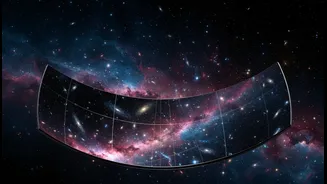
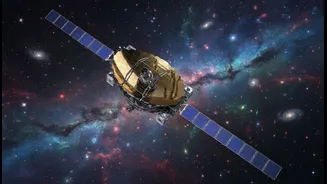
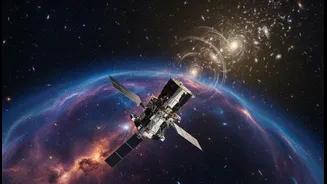
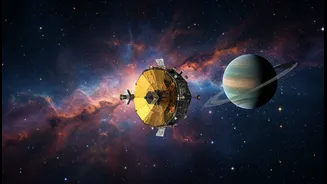
Grace Roman Space Telescope, scheduled for launch in late August 2026, is designed to throw open the curtains. While its primary mirror is the same size as Hubble's, Roman’s Wide-Field Instrument gives it a field of view 100 times larger. In the time it would take Hubble to photograph two galaxies, Roman can capture thousands. It’s not just another camera; it's a cosmic surveyor built to map the universe at an unprecedented scale and speed. This shift in perspective from a deep stare to a wide-eyed scan is what sets Roman apart and positions it to tackle some of the biggest questions in astronomy.
The Hunt for Dark Energy
One of Roman’s primary targets is a force that is completely invisible: dark energy. Scientists know the universe is expanding at an accelerating rate, but they don't know why. Dark energy is the name given to this mysterious pressure pushing everything apart, and it's believed to make up about 68% of the cosmos. Roman will investigate dark energy using three powerful techniques. It will map the 3D positions of millions of galaxies to trace the history of cosmic expansion. It will also track distant stellar explosions called Type Ia supernovae, which act as standard 'mile markers' to measure cosmic distances. Finally, it will study weak gravitational lensing, where the light from distant galaxies is subtly distorted by the gravity of intervening dark matter, allowing astronomers to map the invisible structure of the universe. By creating a vast, high-fidelity map of the cosmos, Roman will provide the statistical power needed to test our theories about what’s driving the universe apart.
A Galactic Census of New Worlds
While Roman charts the grand scale of the universe, it will also be conducting a census on a much smaller scale: exoplanets. The mission is expected to discover thousands of new worlds, but its method is what makes it revolutionary. Instead of looking for the dip in starlight when a planet transits its star (the method used by Kepler), Roman will primarily use a technique called gravitational microlensing. This occurs when a star and its planet pass in front of a more distant star. The gravity of the foreground system acts like a lens, briefly magnifying the light of the background star. This method is sensitive to planets of all sizes, including those with masses similar to Mars, and worlds that are much farther from their star — a region where transit surveys are often blind. This will allow astronomers to find analogues to nearly every planet in our own solar system, providing a truer picture of how common systems like ours are in the galaxy.
The Perfect Partner for Webb
Roman is not a rival or a replacement for the James Webb Space Telescope; it’s a powerful partner. While Webb excels at deep, targeted observations, studying the atmospheric composition of a single exoplanet or the details of a single ancient galaxy, it needs to know where to look. Roman is the ultimate finder scope. Its massive surveys will generate enormous catalogues of interesting objects — from rogue planets wandering alone in space to the most distant quasars. Astronomers can then use Webb and other telescopes to perform the deep-dive follow-up observations. Roman will provide the 'what' and the 'where' on a galactic scale, creating a treasure map of cosmic targets that will keep the scientific community busy for decades. The data from Roman's five-year primary mission is expected to be immense, providing a rich, publicly accessible archive for scientists all over the world, including in India.