




The Penrose Prophecy
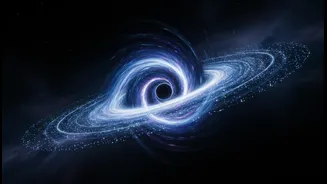
Over 50 years ago, the brilliant physicist Sir Roger Penrose theorized that it should be possible to extract energy from a rapidly spinning black hole. He imagined a particle entering a black hole's "ergosphere" — a region where spacetime itself is dragged
around by the black hole's rotation — and splitting in two. One piece would fall in, while the other could escape with more energy than the original particle had, effectively stealing energy from the black hole. Later, another physicist, Yakov Zel'dovich, built on this, predicting that waves of light or radio could also be amplified by bouncing off a sufficiently fast-rotating object. For decades, this remained a fascinating but untestable theory, as creating those extreme rotational speeds in a lab was mechanically impossible.
From Theory to Tabletop
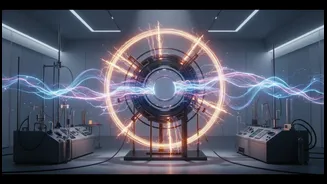
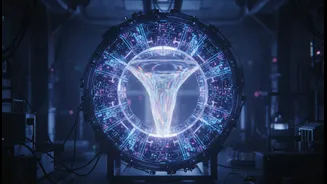
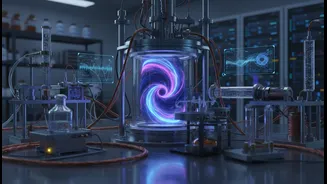
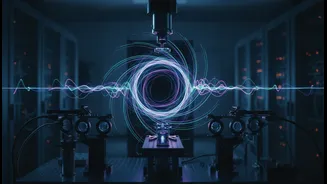
Recently, researchers at the Advanced Science Research Center at the CUNY Graduate Center in New York brought this theory to life. Instead of trying to spin a physical object at impossible speeds, they built a device that creates what they call "synthetic rotation." The team constructed a ring of electronic resonators, and by precisely modulating their electrical properties through time, they created a traveling pattern. To an electromagnetic wave entering the system, it behaved exactly as if it were interacting with an object spinning at an immense speed. This clever workaround allowed them to finally test the decades-old predictions in a controlled laboratory setting.
What Did They Find?
The experiment was a resounding success. The researchers demonstrated that waves sent into their stationary, synthetically rotating system were amplified, just as Zel'dovich had predicted. The waves with specific rotational properties were able to extract energy from the system and emerge stronger. It was the first laboratory demonstration of this black hole-inspired energy extraction phenomenon. This achievement doesn't just confirm a half-century-old theory; it provides physicists with a powerful new tool. It opens a practical way to study extreme rotational effects that were previously only theoretical.
Simulating the Unseeable
This type of experiment is part of a broader field of creating "analogue black holes." These are not actual black holes, but systems that use other media—like sound waves in a fluid or even ultra-cold atoms—to mimic certain properties, such as the event horizon, the point of no return. For example, some experiments create a fluid flowing faster than the speed of sound. Sound waves within that flow cannot travel upstream, creating a sonic "event horizon" very similar to a gravitational one. These setups are crucial for studying phenomena like Hawking radiation, the faint thermal glow Stephen Hawking predicted should emanate from black holes. This radiation is too weak to be detected from actual astrophysical black holes, but in a lab analogue, scientists can observe the process and its effects up close.
Why It Matters for Us
While these experiments won't be powering our homes with black hole energy anytime soon, the implications are significant. Proving these fundamental theories strengthens our understanding of the universe, bridging the gap between the laws of gravity (general relativity) and the bizarre world of quantum mechanics. On a more practical level, the technologies and principles developed could have future applications. The ability to selectively amplify waves could lead to advances in wireless communications, sensor technology, and optics. By pushing the boundaries of what's possible in a lab, these researchers are paving the way for future discoveries and potentially new technologies we can't yet imagine.