


Meet Your New Neighbour: Gliese 12 b
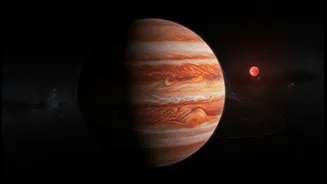
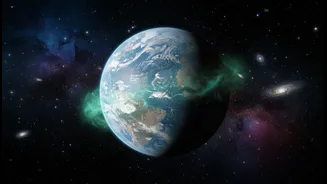
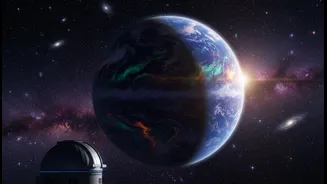
Astronomers have confirmed the existence of a fascinating exoplanet named Gliese 12 b. While 40 light-years is a vast distance—roughly 378 trillion kilometres—in galactic terms, it makes this planet one of our closest known cosmic neighbours. Discovered
by an international team of scientists using data from NASA's TESS satellite and other observatories, this planet is causing a stir for a few key reasons. It's roughly the same size as Earth (or slightly smaller, like Venus) and orbits its star every 12.8 days. But the most thrilling part is its location: it sits in a spot where conditions might be just right for water to exist as a liquid.
The 'Goldilocks Zone' Isn't a Guarantee
Gliese 12 b orbits within its star's 'habitable zone,' often called the 'Goldilocks zone'. This is the region around a star where temperatures are not too hot and not too cold for liquid water to pool on a planet's surface. Gliese 12 b receives about 1.6 times the energy from its star that Earth gets from the Sun, placing it somewhere between the radiation levels of Earth and Venus. Scientists estimate its surface temperature could be around 42°C, assuming it has no atmosphere. While warmer than Earth's average of 15°C, this is still cool enough to potentially allow for liquid water. However, being in the zone is just the first step; the presence of water depends entirely on whether the planet has an atmosphere, and what that atmosphere is like.
A Tale of Two Twins: Earth or Venus?
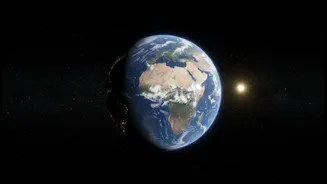
The big question scientists are grappling with is whether Gliese 12 b is an 'Earth twin' or a 'Venus twin'. Both Earth and Venus are in our Sun’s habitable zone, yet one is a lush, life-filled world while the other is a hellscape with crushing pressure and lead-melting temperatures. The difference is the atmosphere. Venus suffered a runaway greenhouse effect that boiled away any water it might have had. Gliese 12 b could have gone either way. Its star, Gliese 12, is a cool, inactive red dwarf. This is good news, as many red dwarfs are known for violent stellar flares that can strip a planet's atmosphere away, which is what may have happened to the planets in the nearby TRAPPIST-1 system. The relative calm of Gliese 12 b's star offers a glimmer of hope that it might have held onto its atmosphere.
The Search for an Atmosphere
Discovering whether Gliese 12 b has an atmosphere is the critical next step. Its proximity and the fact that it 'transits'—or passes in front of its star from our point of view—make it an ideal target for the James Webb Space Telescope (JWST). When the planet transits, starlight filters through its atmosphere (if it has one). Different gases absorb light at specific wavelengths, leaving a chemical fingerprint that JWST's powerful instruments can analyse. By studying these fingerprints, scientists hope to detect molecules like water vapour, oxygen, and carbon dioxide. Finding these would not only confirm the presence of an atmosphere but could also offer the first tantalising hints of biological processes. The planet is considered one of the best opportunities we have to study the atmosphere of a temperate, Earth-sized world.