



The Grand Ambition of a Robotic Mechanic
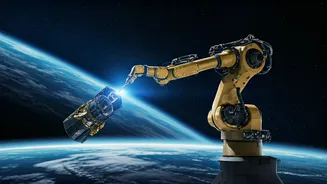
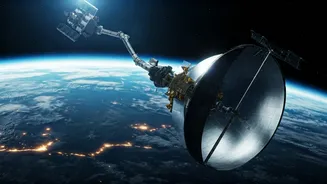
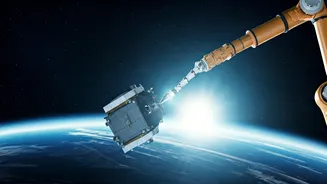
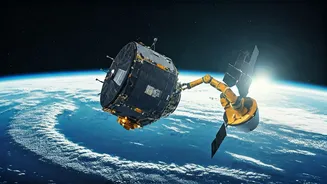
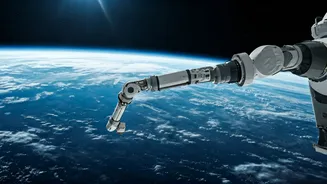
Imagine a robotic mechanic dispatched to the highways of low Earth orbit, tasked with saving a priceless piece of government hardware. This was the vision behind NASA's On-orbit Servicing, Assembly, and Manufacturing 1 (OSAM-1) mission. Its goal was audacious:
to autonomously rendezvous with, capture, and refuel Landsat 7, a crucial Earth-observing satellite launched in 1999. Landsat 7 was never designed to be touched, let alone refueled, after its launch. The OSAM-1 spacecraft was to be a marvel of engineering, equipped with two robotic arms and a suite of specialized tools to cut through the satellite's insulation, unscrew a sealed fuel cap, and pump in fresh hydrazine propellant. It was poised to be the world's first-ever mission of its kind, proving that even legacy spacecraft could be given a second life.
A Reality Check in Zero Gravity
The dream of a universal roadside assistance service for unprepared satellites hit a major roadblock. In early 2024, after nearly a decade of development and an investment of approximately $2 billion, NASA announced the cancellation of the OSAM-1 project. The decision was driven by what the agency called "continued technical, cost, and schedule challenges." Put simply, the task of robotically servicing a satellite not designed for it was proving to be extraordinarily complex and expensive. The cancellation also reflected a broader shift in the space industry. Instead of focusing on difficult, one-off rescues of unprepared spacecraft, the consensus was moving toward designing future satellites to be easily serviced from the outset.
Learning to Fix Things on the Space Station
While OSAM-1 was grounded, the core technologies for in-space servicing had already been quietly proving their worth in a different arena: the International Space Station (ISS). Through a series of groundbreaking demonstrations called the Robotic Refueling Missions (RRM), NASA has used the station's Dextre robotic arm to test the very tools and techniques needed for orbital repairs. These multi-phased missions successfully demonstrated that robots could cut wires, manipulate valves, and, most importantly, transfer fluid—even cryogenic fuel—in a microgravity environment. The RRM program served as a crucial testbed, paving the way for future servicing missions by proving the fundamental concepts were sound, even if the initial application was too ambitious.
A New Generation of Orbital Tugs
The new hope for aging spacecraft lies not in a single, heroic mission, but in an emerging commercial ecosystem. The industry is pivoting to a more sustainable model built on two key ideas. First, new satellites are increasingly being designed with standardized docking ports and accessible refueling interfaces. This makes future servicing missions vastly simpler and more economical. Second, a new class of vehicle, often called a "space tug" or Mission Extension Vehicle, is becoming a reality. These are commercial spacecraft designed specifically to dock with other satellites to provide propulsion, reposition them, or perform repairs. Think of them less as a one-time rescue and more as an orbital taxi service, capable of extending the lives of multiple satellites over their own operational lifetimes.
The Swift Rescue: A Modern Success Story
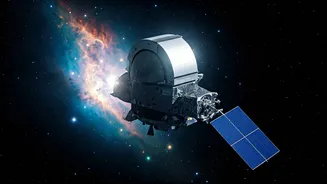
A prime example of this new approach is unfolding right now. NASA's Neil Gehrels Swift Observatory, a veteran telescope launched in 2004, has been losing altitude due to increased atmospheric drag from high solar activity. Instead of a complex internal refueling mission, NASA awarded a contract to the commercial company Katalyst to launch a small spacecraft called "Link." In the summer of 2026, Link is scheduled to rendezvous with Swift and physically attach to it, using its own thrusters to boost the observatory into a higher, more stable orbit. This mission perfectly embodies the new paradigm: a targeted, commercially-led effort to extend the life of a valuable scientific asset that was not originally designed for servicing, providing new hope in a practical, cost-effective way.
Building the Gas Stations of Tomorrow
Looking ahead, the ultimate goal is to create permanent infrastructure that makes refueling in space routine. NASA is actively working on this through missions like the Liquid Oxygen Flight demonstration (LOXSAT), slated to launch in mid-2026. This mission will test critical technologies for storing and transferring cryogenic propellants in orbit—the super-chilled fuels needed for powerful, long-duration missions. Success in this area is fundamental to establishing in-space "gas stations" or propellant depots. Such depots are considered essential for the Artemis program's goals of sustained lunar operations and eventual human missions to Mars, allowing spacecraft to launch with less fuel and top up their tanks in orbit for the long journey ahead.