





A New Era of Moonwalking
The Artemis program represents a monumental leap in space exploration, aiming to establish a long-term human presence on the Moon for the first time. A key destination is the lunar south pole, a region of scientific interest with extreme temperatures
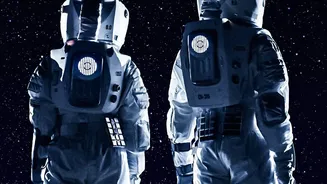
and permanently shadowed craters that may hold frozen water. To conduct meaningful science in this challenging environment, astronauts need more than just a life-support bubble; they need to be able to move. This is where the new Axiom Extravehicular Mobility Unit (AxEMU) comes in. Developed by Houston-based Axiom Space under contract with NASA, these suits are less like clothing and more like personalized spacecraft designed for complex surface operations.
Beyond the Bunny Hop
The most significant upgrade in the AxEMU is its incredible range of motion. While the iconic Apollo suits kept astronauts safe, their rigidity made natural movement impossible. The AxEMU incorporates innovative soft and hard joints at the arms, legs, and even the waist, allowing for a more human-like gait. Astronauts testing prototypes have demonstrated the ability to walk, bend down to collect samples, kneel, and perform other precise geological tasks that were difficult or impossible for their Apollo predecessors. This enhanced flexibility means Artemis crews can cover more ground, investigate complex terrain, and carry out sophisticated experiments far more efficiently.
Designed for a Modern Explorer
Mobility is just one part of the upgrade. The AxEMU is a complete system built for a new generation of diverse explorers. Unlike the custom-fitted suits of the past, the new units are designed to be highly adjustable, accommodating a wider range of body types for both male and female astronauts. The helmet integrates an HD camera and advanced lighting to illuminate the dark craters of the south pole. The suit's outer layers, developed with input from Italian fashion house Prada, are designed to protect against extreme temperature swings and harmful radiation while remaining durable. These features ensure that astronauts can not only survive but thrive during spacewalks that can last for at least eight hours.
The Business of Getting Dressed for Space
The development of the AxEMU highlights a major shift in how NASA operates. Instead of building the suits in-house, the agency has turned to the commercial sector, purchasing spacewalking services from Axiom Space. This approach fosters innovation and allows private companies to develop technologies that can serve both government and future commercial space missions. Axiom Space's design builds upon years of NASA's own research into a prototype called the xEMU but brings a commercial focus on efficiency, scalability, and adaptability. The AxEMU architecture is being designed to be evolvable, meaning it can be adapted for missions in low-Earth orbit and, eventually, for the human exploration of Mars.
A Generational Leap from Apollo
Comparing the Artemis suit to the Apollo suit reveals just how far technology has come in 50 years. The Apollo suits were a marvel of their time, designed for short missions with a singular goal: getting to the Moon and back. The Artemis suits, by contrast, are built for a sustained presence. The AxEMU features a rear-entry hatch, allowing astronauts to dock the suit to a rover or habitat and climb in and out without taking the entire dusty suit inside. Its life support systems are more robust, and its modular design allows for easier maintenance and component replacement. While Apollo astronauts were limited in what they could carry and do, the enhanced dexterity of the AxEMU will allow Artemis crews to use specialized tools with greater precision, unlocking a new level of scientific discovery.