


A New Cosmic Masterpiece
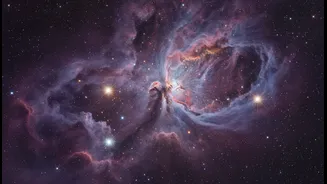
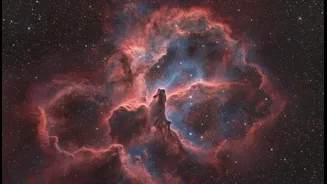
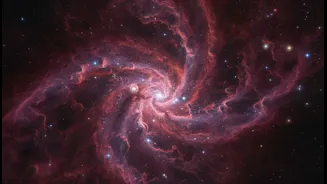
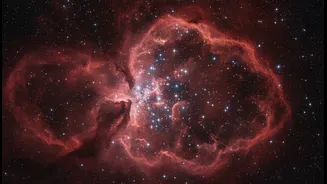
It’s an image that looks more like an abstract painting or a dream of an undersea world than a photograph. A vast, swirling cloud of red and orange gas dominates one side, speckled with intensely bright, blue-white stars. To its side floats a smaller,
isolated bubble of brilliant blue. This celestial vista, nicknamed the 'Cosmic Reef,' is the latest image from the Hubble Space Telescope to go viral, captivating both seasoned astronomers and the general public. The names for the two nebulae are NGC 2014 and NGC 2020, and they are located in the Large Magellanic Cloud, a satellite galaxy of our own Milky Way, about 163,000 light-years away. The nickname comes from its uncanny resemblance to a vibrant coral reef, an association that has made this distant gas cloud feel immediate and wondrous.
What Are We Actually Seeing?
The 'Cosmic Reef' isn't just a pretty picture; it's a dynamic and violent region of space where new stars are being born. The large, red nebula, NGC 2014, is a stellar nursery. Its sparkling centerpiece is a cluster of massive young stars, each 10 to 20 times more massive than our Sun. The intense ultraviolet radiation from these stars heats the surrounding hydrogen and nitrogen gas, causing it to glow with a characteristic red light. These powerful stars also unleash fierce stellar winds that carve out the bubble-like shapes and sculpt the surrounding gas and dust, much like water currents shape a reef. The smaller, blue nebula, NGC 2020, was created by a solitary, mammoth star about 200,000 times brighter than our Sun. This star has been ejecting its outer layers of material in a series of eruptions, and the expelled gas, primarily super-heated oxygen, now glows a distinct blue.
Joining the Hubble Hall of Fame
Hubble has produced many iconic images over its long career, and the 'Cosmic Reef' now joins a celestial hall of fame. Perhaps the most famous is the 'Pillars of Creation,' a haunting image of towering columns of interstellar gas and dust in the Eagle Nebula. First captured in 1995 and revisited in stunning high-definition in 2014, the Pillars showed us a place where stars are being born, hidden within dense clouds. The 'Cosmic Reef' offers a different, more vibrant perspective on star birth. While the Pillars appear dark and shadowy, the Reef is a brilliant explosion of colour. It showcases the sheer power of massive stars to not only form but to actively reshape their environment, painting the cosmos with glowing gas. Each image tells a different part of the story of stellar life cycles, from the shrouded beginnings in the Pillars to the dazzling, energetic display in the Reef.
The Enduring Legacy of Hubble
Released to commemorate the telescope’s 30th anniversary, the 'Cosmic Reef' is a testament to Hubble's incredible longevity and power. Launched on April 24, 1990, the space telescope has made over 1.4 million observations, providing data for more than 17,000 scientific papers. It has fundamentally changed our understanding of the universe, confirming the existence of supermassive black holes and helping to uncover the mystery of dark energy. While newer instruments like the James Webb Space Telescope are now peering even deeper into the infrared universe, Hubble continues to provide invaluable data and breathtaking images in visible and ultraviolet light. The telescope has become more than a scientific instrument; it is a cultural icon, our shared window to the cosmos that consistently inspires awe and wonder. Images like the 'Cosmic Reef' remind us why we look to the stars in the first place.