






What Exactly Is a Personal Item?
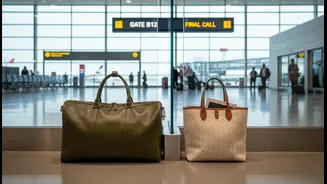
In the world of air travel, a 'personal item' is not a subjective term. Airlines define it as a small bag that must fit completely under the seat in front of you. Think of a ladies' handbag, a slim laptop bag, a small camera bag, or a compact backpack.
The key is its destination: if it’s destined for the space by your feet, it’s a personal item. If it’s too large and needs to go into the overhead bin, it crosses the line into carry-on territory. While most airlines in India allow one personal item in addition to your main cabin bag, this isn't a universal rule, especially with budget international carriers where your ticket might only cover a personal item. The purpose is to allow you to keep essentials like your wallet, phone, medication, and a book within reach during the flight without cluttering the cabin or aisles.
The Carry-On vs. Personal Item Showdown
The main difference between a personal item and a carry-on bag comes down to size and storage location. A carry-on bag, often a small roller suitcase or a larger duffel bag, is designed for the overhead bin. Airlines provide specific dimension and weight limits for these, which you must adhere to. A personal item, on the other hand, is significantly smaller and its size is governed by the space under an airplane seat. For instance, Air India specifies personal item dimensions around 40 x 30 x 20 cm, while IndiGo also has strict size and weight limits for these smaller bags. A carry-on bag is for your change of clothes and bulkier items for a short trip, while the personal item is for in-flight necessities. Getting this wrong can be costly, as an oversized personal item will be reclassified as a carry-on, often resulting in hefty gate-check fees.
Why Airlines Enforce the Rules So Strictly
It might feel personal when a gate agent eyes your bag suspiciously, but the enforcement is driven by two major factors: logistics and revenue. Logistically, there's a finite amount of space in an aircraft's cabin. If passengers bring oversized personal items, the overhead bins fill up before everyone has boarded, leading to delays as crew search for space and gate-check remaining bags. It also creates safety issues if bags are cluttering aisles and exit rows. Financially, baggage fees are a cornerstone of modern airline profitability. Known as 'ancillary revenue,' these fees from checked bags, overweight carry-ons, and other add-ons generate billions of dollars for the industry globally. By strictly defining what a 'free' personal item is, airlines protect a valuable revenue stream derived from passengers who need to carry more.
A Guide to Indian Airline Policies
Rules can vary, so checking your specific airline's policy is non-negotiable. For major Indian carriers, the policies are relatively consistent but have nuances. Air India generally allows one piece of cabin baggage (up to 8 kg) and one personal item, such as a laptop bag or handbag, which should not exceed 3 kg. IndiGo permits one cabin bag (up to 7 kg) and an additional personal item like a small laptop bag or ladies' purse, also with a weight limit, often around 3 kg. Vistara allows one piece of hand baggage with a weight limit that varies by class (7 kg for Economy) and also permits an additional smaller item like a handbag or laptop case. The common thread is that the personal item is always secondary, smaller, and must fit under the seat. Always check the airline's official website before you pack, as policies can be updated.
Tips to Avoid Extra Fees and Travel Smoothly
Being a savvy packer can save you both money and stress. First, measure your personal item at home to ensure it complies with your airline's dimensions. Opt for soft-sided bags like backpacks or totes over rigid ones, as they can be squished to fit into the bag sizer or under the seat more easily. Pack smart: consolidate your items. Instead of carrying a separate camera bag, purse, and shopping bag, try to fit them all into one qualifying personal item. Wear your bulkiest clothing, like a jacket or heavy boots, on the plane instead of packing them. Finally, if you know you're cutting it close, it's almost always cheaper to pay for a checked bag online in advance than to be surprised with a penalty fee at the boarding gate. A few minutes of preparation can make the difference between a relaxing start to your journey and a frantic, expensive one.