




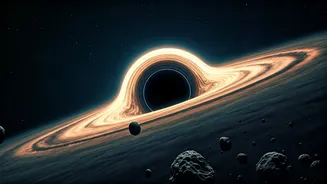


A Perfect Ring in the Cosmos
The latest buzz-worthy image from the Hubble Space Telescope showcases a stunning and exceptionally rare celestial alignment known as an Einstein Ring. While other examples have been found, this new observation is remarkable for its completeness. An Einstein Ring is formed
when a massive object, like a galaxy, sits directly in front of a more distant one from our point of view. The immense gravity of the foreground galaxy acts like a lens, bending the light from the background object into a beautiful, glowing halo. It's a visual confirmation of one of the most profound theories in modern physics, seen in breathtaking detail.
Gravity's Magnifying Glass
So how does this work? It all goes back to Albert Einstein's theory of general relativity. He predicted that massive objects don't just pull on other things; they literally warp the fabric of spacetime around them. Imagine placing a bowling ball on a stretched-out sheet—it creates a dip. Now, roll a marble past it. The marble's path will curve because it's following the dip created by the bowling ball. Light behaves similarly. As light from a very distant galaxy travels toward us, its path is bent when it passes through the curved spacetime around a massive foreground galaxy. This effect, called gravitational lensing, can distort, magnify, and even create multiple images of the background object. When the alignment is just right, the light is smeared into a complete circle—the elusive Einstein Ring.
A Textbook Example Brought to Life
This is where the "science classroom energy" comes in. Gravitational lensing is a fundamental concept taught in astronomy and physics courses to explain general relativity. Students often see diagrams showing how light bends, but seeing a real-life, near-perfect ring is a powerful educational moment. It’s the universe providing the ultimate visual aid. What makes some of these discoveries even more special is when multiple objects align perfectly. In one famous case, Hubble found a double Einstein Ring, where light from two different background galaxies was bent by a single foreground galaxy, creating a cosmic bull's-eye. Such finds are exceptionally rare, estimated at one in 10,000, but they provide an incredible natural laboratory for studying the universe.
More Than Just a Pretty Picture
These rings are far more than cosmic curiosities; they are powerful scientific tools. The precise shape and size of an Einstein Ring allow astronomers to calculate the mass of the foreground galaxy with incredible accuracy. This is especially important for weighing things we can't see, like dark matter, the mysterious substance that makes up about 85% of the matter in the universe. By studying how light is lensed, scientists can create 3D maps of where dark matter is distributed. Furthermore, gravitational lensing acts as a natural telescope, magnifying light from extremely distant galaxies that would otherwise be too faint for even Hubble to see. This allows us to peer deeper into the early universe and study how the first galaxies formed.
Hubble's Enduring Legacy
Even with the newer James Webb Space Telescope making incredible discoveries, Hubble continues to be a vital instrument. Its ability to observe in visible and ultraviolet light complements Webb's infrared view, giving a more complete picture of the cosmos. Discoveries like this stunning Einstein Ring reinforce Hubble's legacy not just as a tool for groundbreaking research, but as an unparalleled educator. For over three decades, it has helped determine the age of the universe, confirmed the existence of supermassive black holes, and brought the cosmos into our homes and classrooms. It continues to show us, in the most brilliant ways, that the laws of physics are not just abstract equations but are actively shaping the magnificent universe around us.