
Our Star’s Destructive Tantrums
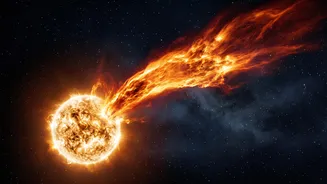
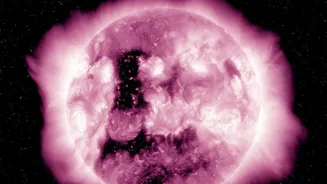
A solar storm is an eruption of immense energy from the sun. These events, like solar flares and coronal mass ejections (CMEs), send a stream of charged particles hurtling through space. If Earth is in the path of one of these CMEs, the particles interact
with our planet's magnetic field, creating what is known as a geomagnetic storm. While this can produce beautiful auroras far beyond their usual polar regions, the effects on our technological infrastructure can be far from pretty. The most famous example, the Carrington Event of 1859, set telegraph systems on fire. A similar storm today would find a world infinitely more dependent on vulnerable electronics.
Why Modern Society Is So Vulnerable
Our modern, connected world runs on systems that are highly susceptible to geomagnetic disturbances. When a solar storm hits, it can induce powerful, uncontrolled electrical currents in long conductors on the ground. This is particularly dangerous for national power grids, where these currents can overload transformers, causing them to fail and leading to widespread, long-lasting blackouts. Beyond the power grid, the sensitive electronics in satellites are at risk. This can disrupt GPS signals, which are crucial not just for navigation apps on our phones but for everything from aviation and shipping to financial transactions and precision agriculture. Communication systems, from radio to the internet, can also be severely impacted.
The Challenge of a Cosmic Forecast
Predicting this 'space weather' has been a persistent challenge for scientists. While we can see eruptions on the sun's surface, determining which ones will hit Earth and how severe their impact will be is incredibly complex. Traditional models often provided warnings that were either too late or not specific enough for utility companies and satellite operators to take effective preventative action. For years, the best we could hope for was a very short notice period, often not enough time to properly safeguard multi-billion dollar assets and essential services that entire nations rely on.
Enter DAGGER: NASA’s AI Shield
To tackle this problem, NASA has spearheaded the development of an advanced artificial intelligence model named DAGGER (Deep Learning Geomagnetic Perturbation). This system represents a major leap forward in space weather forecasting. Instead of relying on older, slower models, DAGGER uses deep learning—a type of AI—to analyze real-time data from satellites monitoring the solar wind, the stream of particles constantly flowing from the sun. By finding hidden patterns in this data, it can predict the specific location and intensity of geomagnetic disturbances around the globe with remarkable speed and accuracy.
A 30-Minute Warning to Save Trillions
The key advantage of the DAGGER system is its ability to provide a reliable 30-minute advance warning before a storm's impact. This might not sound like much, but in the world of infrastructure management, it is a game-changer. That half-hour window gives power grid operators time to reroute power or take transformers offline to prevent catastrophic damage. It allows satellite controllers to put their spacecraft into a protective 'safe mode' to shield sensitive electronics from harmful radiation. According to Vishal Upendran, a lead researcher on the project from the Inter-University Center for Astronomy and Astrophysics in India, this AI makes it possible to minimize or even prevent devastation to modern society.